
 Winifred Nwania
You are a brand. The question is did you build it or did people build it for you?
Something happened in my office not too long ago. A young woman came in to pitch me on a service she wanted to offer. She was clearly talented and clearly passionate, and everything she said made sense.
But as she was speaking, I noticed that she kept shifting restlessly in her chair back and forth, back and forth, the whole time she was talking.
So I stopped her gently and asked, “Are you nervous?” She said no. I asked again, a little later, and she said no again. And then I said, “Then please stop moving.” She looked down at herself and went completely still. She had no idea she was doing it.
In that moment, the message her body was sending me was completely different from the words coming out of her mouth. She was telling me she was confident and ready. Her body was telling me she was unsure of herself.
Here is the thing about personal branding that I really want you to understand: her brand was speaking before she had any idea what it was saying.
This is the reality for most people. They go through their days making impressions, shaping perceptions, and leaving people with feelings about who they are, and are doing all of this whether they are conscious of it or not.
Your personal brand is not something you create when you decide to “work on your brand.” It has been forming since the first day someone laid eyes on you. The only question worth asking is: Is the brand that has been building itself actually representing you the way you deserve to be represented?
Knowing how to build a personal brand intentionally ensures that your reputation works for you, not against you.
In this guide, we will break down what it takes to audit your current presence and build a lasting impression.
🎁 FREE DOWNLOAD: Your Personal Brand as a Superpower
You already have a personal brand. The question is whether it is working for you or against you.
Download this free guide and discover how to identify your brand strengths, close the gap between how you see yourself and how the world sees you, and start showing up with the kind of clarity and consistency that makes people remember you for all the right reasons.
➤ Yes send me the free guide here
What Is a Personal Brand, Really?
The first thing we need to do is clear up the misconception that has held so many people back from taking this seriously. When most people hear the word “branding,” they think logos. They think colour palettes, business cards, and aesthetic Instagram feeds. And while all of those things are part of a brand, they are actually the last part — not the first.
Adebimpe Mohammed, personal branding expert and co-tutor of The Art of Personal Branding course here at Winnie’s School of Excellence, puts it in a way that I think is one of the clearest definitions I have ever heard:
“Branding is the way you are perceived, how you are talked about, and how people feel about you when you are not in the room. That is it. Not your logo. Not your colours. The feeling people are left with after they have encountered you.”
I personally define personal branding as the lifelong process of intentionally shaping the person you are becoming and consistently expressing that person through your character, values, competence, relationships, communication, appearance, and contributions, so that your life communicates a clear and trustworthy identity.
And there are only two ways to build a personal brand:
- You design it intentionally…
- or life designs it by default.
When Adebimpe and I sat down to discuss this topic, one of the things she said that completely shifted my thinking was that branding is life because life is about how people perceive you in every area, not just professionally:
- The stay-at-home mother who feels invisible to her husband.
- The professional who works harder than everyone else but never gets the promotion.
- The entrepreneur who has a brilliant product that nobody seems to be buying.
In every single one of those situations, a personal brand is at work. The question is simply whether the person in the story has chosen to be the author of it or not.
Why Learning How to Build a Personal Brand Matters

Your Brand Is Influencing Decisions You Do Not Even Know About
Here is something that people rarely talk about when it comes to personal branding, and I think it is one of the most important things to understand.
Research consistently shows that people make branding decisions, whether they are hiring you, purchasing from you, choosing to date you, promoting you, or trusting you with something important, based on how they feel about you, not just what you offer.
In fact, a 2026 Aurora University survey found that professionals now rank personal branding as more important than their CV. More important than their CV. That tells you everything about how much the world has shifted.
The most talented person in the room does not always win. The most trusted person does. And trust is built not just through competence, but through the consistency and clarity of how you show up.
Your personal brand is the thing that either builds that trust before you even walk through the door, or quietly erodes it without you ever realising it is happening.
The Zoom Framework: A Practical Way to Think About Your Personal Brand
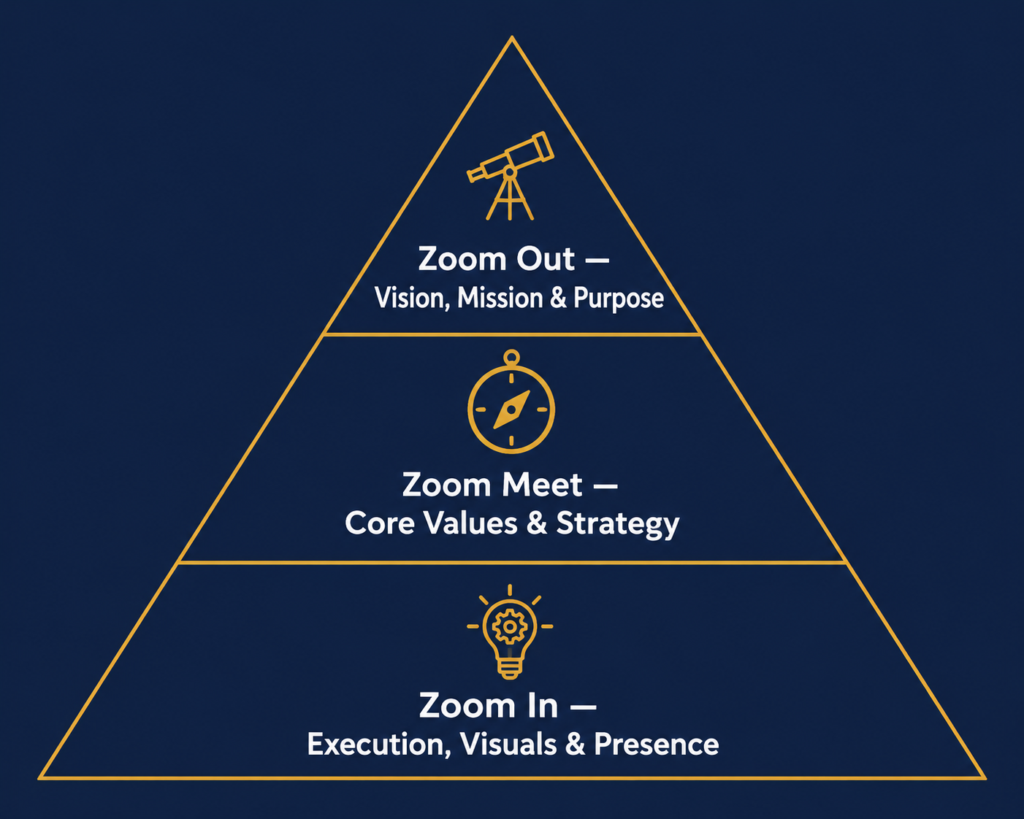
One of the most useful tools that Adebimpe shared with me during our sit down conversation on YouTube is what she calls the Zoom Framework, and I want to walk you through it here because it has genuinely changed how I think about building a brand.
The framework has three levels, and the beauty of it is that it forces you to go in the right order. Most people start at the bottom and work their way up. The Zoom Framework teaches you to start at the top and work your way down.
Zoom Out — The Big Picture
The first level is where you establish your foundation. This is where you ask the most important questions:
Why do I exist?
What is my vision for my life or my work?
Who are the people I want to serve, speak to, and build with?
What cultural values do I want to uphold through the way I show up?
These are not surface-level questions, and they are not questions you answer once and forget about. They are the bedrock of everything else you will build. Without this foundation, your brand will always feel inauthentic.
Zoom Meet: The Strategy
The second level is where you get specific about who you are on the inside. This is where you define your core values and I do not mean the polished version of your values that sounds good on paper. I mean the real ones.
- Are you genuinely committed to excellence?
- Are you honest even when it is uncomfortable?
- Are you kind even when no one is watching?
These values are the character of your brand, and they are what determine whether people’s experience of you matches the image you are projecting. This is also where you niche down your audience, not just broadly, but specifically. Who exactly are you speaking to, serving, and building for?
When personal brand strategist Adebimpe met me for the first time, one of the first questions she asked was: who is your target audience? And when I said men and women, she took me to my YouTube channel and showed me, gently and clearly, that almost everything I was putting out was heavily weighted towards women.
I thought I was building for everyone. My content was telling a different story. That one conversation led directly to us launching the Dear Men series, because I had to start being intentional about what my brand was actually saying, not just what I intended it to say.
Zoom In: The Execution
This is the level that most people start at, and that is why so many brands feel hollow. The Zoom In level is where your logo lives, your colour palette, your visual identity, your outfits, the way you carry yourself, the way you communicate.
All of these things matter enormously but only when they are the outward expression of something real that was built at the first two levels. When they are not, they become what Adebimpe calls, “packaging without content”, which is one of the most damaging things a brand can be.
When the Inside Matches the Outside: Brand Interception
After going through the Zoom Framework, you’ll finally arrive at something Adebimpe calls brand interception, and I think it is one of the most powerful ideas in this entire conversation.
Brand interception is the moment when your internal brand and your external brand come together, where who you are on the inside is exactly what people experience when they encounter you on the outside.
That alignment is what creates real, lasting trust.
She used a business principle that I think translates beautifully to personal branding:
Under-promise and over-deliver.
If the way you present yourself to the world is a ten out of ten, then when people zoom in, when they actually spend time with you, work with you, or do business with you, let them experience a twenty.
Not less. Not the same. More. Because the most powerful personal brands are the ones that exceed the expectation they set, every single time.
I have experienced both sides of this, and I am sure you have too. There are people I have admired from a distance who, when I finally met them, had almost nothing behind the image they had built.
And there are people who seemed interesting online but were absolutely extraordinary in person. The second kind is the brand I want to build. The kind where people walk away feeling like they received far more than they expected.
The Bible actually speaks to this principle directly. Romans 14:16 says, “Let not your good be evil spoken of.” Think about that for a moment. It does not say you are not good. It says there is a possibility that your goodness can be perceived as something else entirely if your branding is poor.
Your gifts, your kindness, your competence, all of it can be misread if you are not intentional about how you communicate and present yourself. That is how powerful branding is, and how costly its absence can be, and this is what we cover in the Art of Personal Branding
Live on Brand, Not on Emotions
When Adebimpe was wrapping up our conversation, I asked her to give one piece of advice to anyone who wanted to start their personal branding journey, and what she said has stayed with me since. She said: Live on brand, not on emotions.
Once you have defined your core values, once you know who you are and what you stand for, your commitment is to live those values consistently, not just when it is convenient, not just when people are watching, but all the time.
She gave such a simple but powerful example: if you want to build a brand that is synonymous with excellence, then your house should look like excellence even before the guests arrive. Not because you are performing for anyone, but because excellence is simply who you are.
Personal branding requires grit, discipline, and a willingness to keep choosing your values even when your emotions are pulling you in a different direction.
There will be days when you are tired, frustrated, or under pressure, and in those moments, your brand will either hold or it will slip. The goal is not perfection. The goal is self-awareness and intention, so that when you do slip, you notice it, you own it, and you make a U-turn.
For anyone starting out, my advice is this: build inwards first.
Start with who you are on the inside, your values, your vision, your why, before you touch anything on the outside. Because when you try to build a brand from the outside in, it will always feel like a costume rather than a character. And people can always tell the difference
That’s why I created the Vision and Purpose Mastery webinar to help you understand your purpose and map out your vision clearly so that creating your personal brand stems from an empowered understanding of your true identity, of your true abilities and infinite potential
Ready to Build Your Personal Brand with Intention?
Expert brand strategist, Adebimpe Mohammed and I created The Art of Personal Branding. It’s a course specifically for people who are ready to stop leaving their brand to chance and start building it with purpose.
Across 6 structured modules, we will walk you through everything from
✔️Uncovering your Brand DNA to crafting your personal brand statement,
✔️Building your visual and digital presence,
✔️Developing your communication and influence skills, and positioning yourself to attract the right opportunities and income.
This is not a course about becoming someone you are not. It is a course about finally, clearly, powerfully communicating who you already are.
You will also walk away with a Certificate of Completion from Winnie’s School of Excellence.
The Brand You Were Always Meant to Build
Your personal brand is not about becoming more visible. It is about becoming more intentional. When the person on the inside and the person people see on the outside are the same person, something extraordinary happens.
People trust you. Opportunities find you. And the right doors open, not because you pushed harder, but because your brand made it undeniable that you belonged on the other side of them.
That is the kind of brand you deserve to build. And everything you need to build it is already inside you. It just needs a little direction.
Key Takeaways
Your Brand Precedes You: A personal brand isn’t something you start building from scratch; it has been forming since your first interaction. The goal is to take control of the narrative.
Perception Dictates Opportunities: Decisions regarding hiring, promotions, or purchasing are heavily driven by how people feel about you, not just what is written on your CV.
The Zoom Framework Priority: Successful personal branding must be built from the inside out: establish your vision (Zoom Out), define your core strategy and audience (Zoom Meet), and only then execute your visual identity (Zoom In).
Brand Interception Equals Trust: Real trust is established at the intersection where your internal values perfectly align with your external presentation, always aim to under-promise and over-deliver.
Consistency Over Emotion: Building a sustainable brand requires the discipline to consistently live out your core values, even when emotions or fatigue tempt you to slip.
Frequently Asked Questions (FAQs)
What is a personal brand?
A personal brand is the unique combination of skills, experiences, and values that define how the world perceives you. It is ultimately how people talk about you and how they feel about you when you are not in the room.
Why is building a personal brand important?
In today’s professional landscape, trust is the ultimate currency. Research shows that professionals now rank a personal brand as more important than a CV. A strong, intentional brand builds credibility before you ever walk through a door and helps align your true capabilities with how you are compensated and valued.
How do I start building my personal brand?
The best way to start is from the inside out. Begin by defining your foundational “why,” your long-term vision, and your core values. Avoid focusing immediately on superficial elements like logos or color schemes; instead, focus on your core strategy and clearly identify who your specific target audience is.
To learn how to build and perfect your personal brand from scratch, click here to explore The Art of Personal Brand
What is the Zoom Framework in personal branding?
The Zoom Framework is a three-tiered approach to brand building developed by Adebimpe Mohammed. It includes:
- Zoom Out: Setting your foundation, vision, and long-term values.
- Zoom Meet: Outlining your strategy, core values, and specific target audience.
- Zoom In: Executing your visual identity, communication style, and presentation.
What does it mean to “live on brand”?
Living on brand means committing to your core values consistently rather than operating based on temporary emotions. It means practicing excellence, honesty, and alignment in your daily life, even when no one is watching, so that your outward packaging always matches your inward character.
Recent Posts
-

What Is Your Personal Brand Telling People About You?
September 11, 2026 -

Your Growth is Not Optional: Why Skill Development is Your Best Offensive Weapon
September 4, 2026 -

Your Purpose Has a Plan. Now Do You Have the Grit to See It Through?
August 28, 2026 -

You Know Your Purpose. Now What? The 7-Step Blueprint to Turn a Burning Desire Into a Plan That Actually Works
August 21, 2026 -

Your Purpose Is Not Missing. It Is Disguised as Something You Already Do for Free
August 14, 2026