Winifred Nwania

Scroll through any social media app today and count how many bios say CEO. Founder. Visionary. Boss. Now count the ones that say “currently serving.”
I’ll wait… did you find any?
We live in a world that celebrates the person at the head of the table. We clap for the founder who calls the shots, the CEO on the magazine cover, and the director with the corner office. And there is nothing wrong with wanting to originate something. Creating, inventing, and building are part of how God made you, and we talked about that last week.
But here is what nobody tells you about the people we celebrate. Almost every one of them passed through a season you never saw. A season where they were not in charge, where they took instructions, met someone else’s deadlines, and carried someone else’s vision on their back. And that season, the one most people try to skip, is exactly where they learned to lead.
That season has a name. It is called service.
Keep reading to Lessons 3 and 6. There is a free tool 🎁 waiting for you that will help you turn the pressure at your job into something profitable.
I Promised You Time. Let Me Explain.
In my last post, I showed you that self-mastery is the first attribute of every great leader. Before you lead anyone else, you must first lead yourself. I also promised that this week we would talk about time management.
We will get there. But as I prepared that post, something became clear to me. Most of us do not learn to manage time from a book. We learned it from a deadline someone else set, in a job we sometimes did not even want, under a boss who would not accept excuses. The same is true for managing resources and managing people. The art of service is the classroom where all of them are taught.
So before we talk about leading your hours, we need to talk about service which differentiates a true leader from someone who just holds a title.
What Is Service, Really?
Apostle Joshua Selman puts it this way in his teaching on service: serving goes far beyond simply showing up. It means becoming an active participant in birthing and manifesting the purpose of the organisation you belong to. This may be your family, friend groups, work, church, community, school, or wherever you currently identify as your community. It means committing your time, your energy, your gifts, and your resources to the work, and it means standing firm when it gets hard instead of chickening out.
Service is a prerequisite of leadership. If you do not serve, or you do not like the idea of serving, you are not yet qualified to lead, no matter what title sits on your business card. CEO, director, HOD, manager: the title tells people where you sit. Service tells them whether you deserve the seat.
This is not a new idea. In the Bible, when the disciples started arguing about who would be the greatest, Jesus turned the whole thing upside down:
“But so shall it not be among you: but whosoever will be great among you, shall be your minister: And whosoever of you will be the chiefest, shall be servant of all” (Mark 10:43-44, KJV).
Almost two thousand years later, a retired AT&T executive named Robert Greenleaf put the same truth into business language. In his 1970 essay The Servant as Leader, he argued that the leaders people trust most are servants first. The desire to serve comes before the desire to lead, and true leadership grows out of the willingness to serve.
Simon Sinek summed it up in one line I love: “Leadership is not about being in charge. It is about taking care of those in your charge.” You cannot take care of people well if you have never been one of the people being led.
Service Is Not Being a Doormat
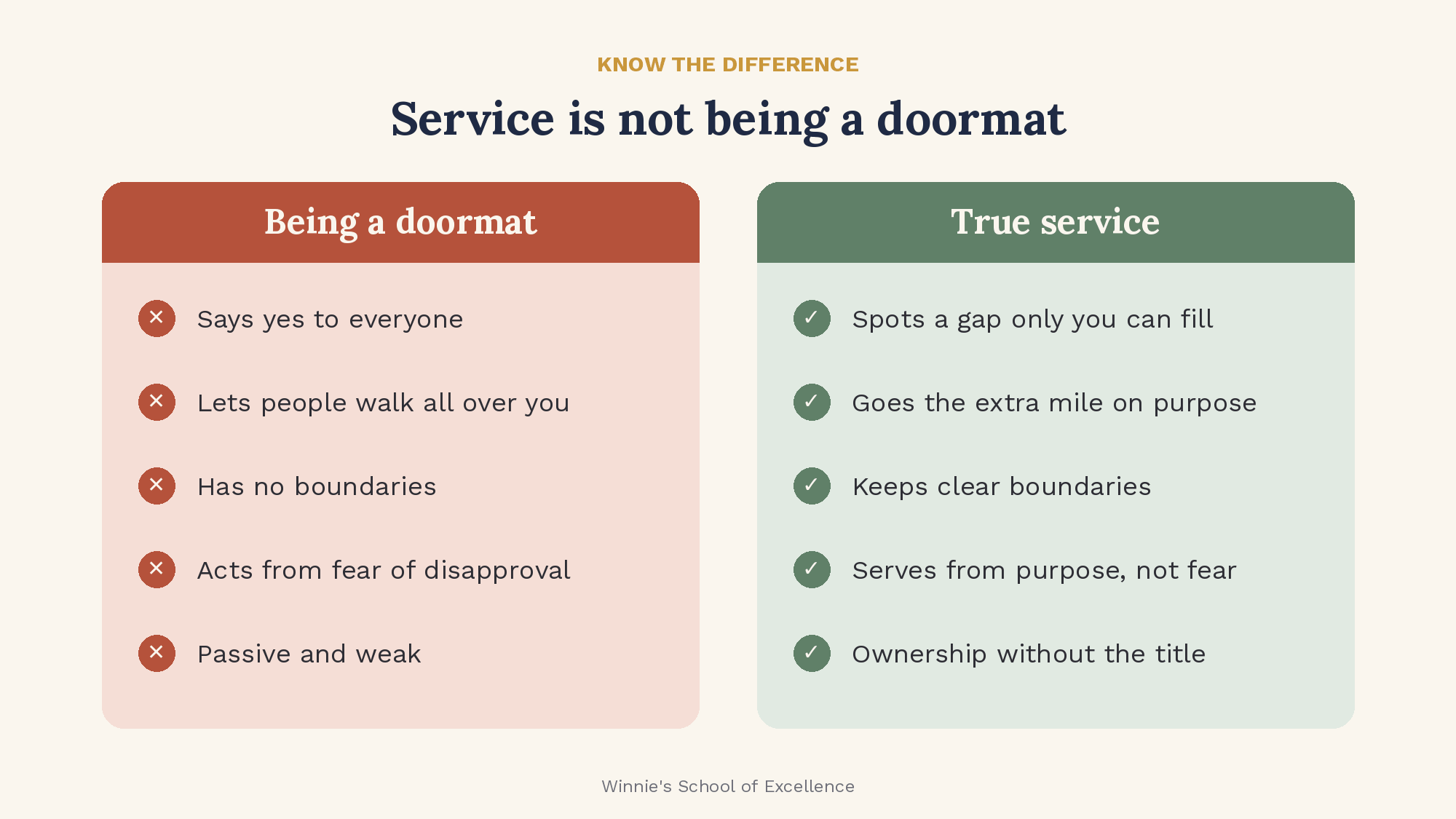
Let me clear something up before we go any further. Service does not mean saying yes to everyone. It does not mean letting people walk all over you, and it does not mean having no boundaries.
Service means going above what is expected, not for recognition, but because you have identified a gap in the operations that you know your contribution can fill, and you are proactive enough to hold that gap together so the organisation does not fall.
It is not passive. It is not weak. It is ownership without the title.
Simon Sinek said something in a recent interview that puts this beautifully. When he asked his closest friends why they valued him, what they eventually described was the space he fills in their lives. Your value to the world, he said, is the space you fill in other people’s lives. That is service. Finding the space only you can fill, and filling it well.

And here is the beautiful part. In the place of true service, you will always find opportunities to profit that you would never have seen if you had not gone the extra mile. The extra mile is where the hidden doors are.
Sinek’s own career is proof. He had spent some time during a season in his life trying to understand who he was, what his purpose on earth was, and “why” he wanted to build or do anything at all in life.
Before the books and the stages, he was simply helping his friends also discover their “why,” because it had helped him change his life and find joy and clarity in life, he wanted them to have it too. His friends told other people who eventually asked him to come and speak in their living rooms.
He started helping people for a hundred dollars on the side. The people he served introduced him to the people they knew, until one of them introduced him to a publisher who took a chance on him in publishing his first book.
That’s why when I defined the term service, I intentionally included “friend groups” as a place you could serve, not by going to their homes and cleaning or doing their laundry.
No. You don’t need to do any of that.
But simply sharing what has helped you, what you’ve learned, and how it has changed your life so it could change theirs too. This is actually a wholesome way to think about sharing your story and content on social media and building your personal brand.
Simon Sinek did not chase the platform. He served his friends with the answers that he uncovered and ended up serving the world with the answers that changed his life.
Someone on My Team Learned This the Hard Way
Irene, a copywriter on my team here at WSE shared something with me recently, and she has allowed me to share it with you, because I think a lot of you will see yourselves in it.
In her words: “Before I started working with WSE, I was very intelligent but inconsistent, and if I am honest, borderline lazy. I had a vision for my life. I knew my purpose and I wanted to be consistent, I had tried to be consistent with my goals in the past, but I never saw it through.”
Then she found herself working with a visionary in an organisation where nobody sat her down to lecture her about consistency. Consistency was simply the order of the day. Every day she had to give an account. Every day she had to show up. And excuses were not tolerated.
So she stretched herself, whether it was convenient or not, until showing up stopped being a struggle and became second nature. As she reflected on her own life, she told me the Holy Spirit showed her how much service had changed her. The thing she had tried and failed to build on her own for years was built in her through serving someone else’s vision.
Read that again. She did not lack purpose. She did not lack intelligence. She lacked the daily structure that forces you to follow through, and service gave it to her.
Destiny Is Not Emotional
Part of what Irene learned is that excuses had to go. And one of the hardest excuses to let go of is the one that comes from “how we feel”.
Now, let me be very clear here, because I do not want anyone to misunderstand me. Pain is real, and it should be cared for. If you have a headache, rest, eat something, take something for it, and if it keeps coming back, go and get tested. If your heart is broken, that pain deserves time, space and people who love you around you. Caring for yourself is part of leading yourself, as we said last week.
But there is a difference between caring for your pain and handing it the steering wheel of your life. Your pain deserves care, but it does not deserve to control your life or the commitments you’ve made with your destiny.
Because the truth is: destiny is not emotional, life is not emotional. If every heartbreak, every family issue and every bad mood gets you to shut down your work for days, weeks and sometimes months at a time, you will never stay consistent long enough to see your vision break even.
So give your emotions their proper place. Tend to them deliberately, at the right time and in the right way, but in all that you do, do not break the promises you made to yourself, do all you can to keep your appointments with your future. That is the surest way to guarantee that you can achieve your dreams.
Your Job Is Raw Material, Not A Detour

I have noticed a costly mistake many people make. They have a job, and they have something they are building on the side. And because the job is not “aligned to their purpose,” they loathe it. They do it half-heartedly. They count the hours. They give it the leftovers of their energy and save the best of themselves for “their real thing.”
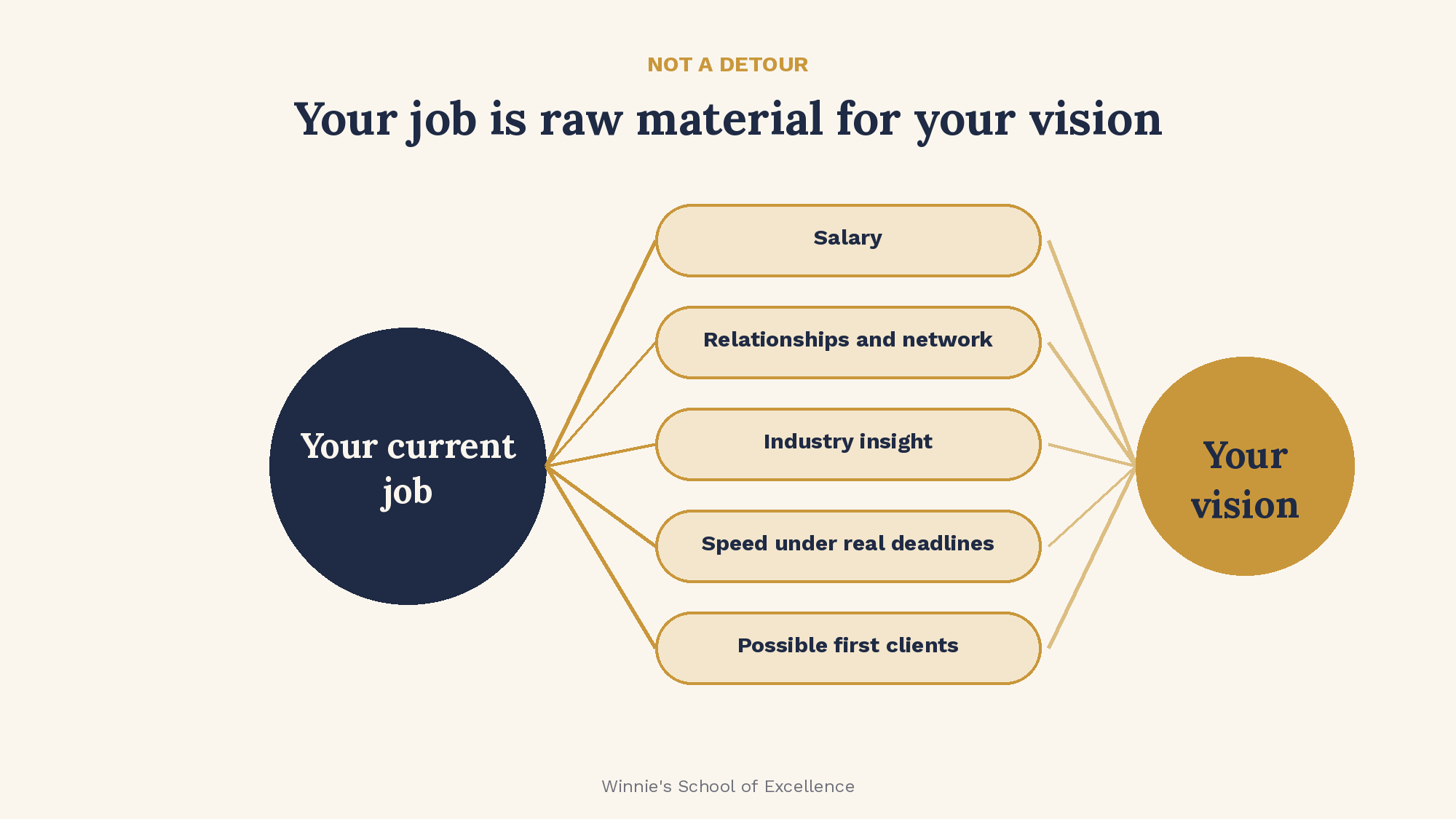
Here is what you may not have realised. The job you are in right now is raw material for the purpose you desire to fulfill. And I am not only talking about the salary at the end of the month.
I am talking about relationships and network. I am talking about a unique perspective on that particular industry that most outsiders will never have. You could even shape your side venture to offer value to the people in the industry you currently work in, and those people could become your very first clients when you eventually leave.
I am also talking about speed. Deadlines with real consequences force you to find new ways to get your work done excellently and on time. If you have been complaining about the pressure, I honestly sympathise with you. But look at it in a different light. You are learning time management, energy management, excellence and consistency, and those skills spill over into the rest of your life.
Now, nobody said serving people was going to be easy. You may have a difficult boss. You may be in a strict work culture that does not care how you feel. But if you have decided that you are not going to quit, then do not stay with one foot out of the door. Embrace it and learn everything you can. Half-hearted service wastes the classroom you are already sitting in.
In that same interview, Simon Sinek spoke about people who feel completely misaligned with the company they work for. He said quitting is always an option, but it is not the only option. And then he asked a question I want you to sit with: “Do I quit? Or do I be the leader I wish I had?”
You can bring inspiration to the person on your left and the person on your right. You can build a small pocket of excellence and fulfilment in your own team, even inside a company whose values you do not share. As he put it, there are good people and great teams inside bad companies all the time. Your company’s culture does not have to become your character.
Jesus asked a question that should sit with every one of us who wants something of our own:
“And if ye have not been faithful in that which is another man’s, who shall give you that which is your own?” (Luke 16:12, KJV).
Stewardship requires faithfulness. A great steward has learned to take care of another person’s property as if it were their own, and that posture is what prepares them to lead themselves, and their own visions or businesses.
What an Oil Company Taught Me About Building a School
Let me tell you a little of my own story.
Before I built Zeelicious Foods, and long before Winnie’s School of Excellence, I worked in an oil company for two years.
It was not my dream job, and it was not my final destination. But it was there that I learned about systems and structures: how a large organisation is organised, how teams are set up to move towards one goal, how processes keep things running even when people change.
When it was time to build my own organisations, I did not start from scratch. I started from everything I had observed while serving someone else’s vision.
7 Lessons Service Teaches That No Classroom Can
The author Robert Greene studied the lives of masters across history for his book Mastery, and one pattern kept showing up. Before they produced their greatest work, almost all of them went through an apprenticeship phase, a season where the goal was not money or status but learning as much as possible from the inside.
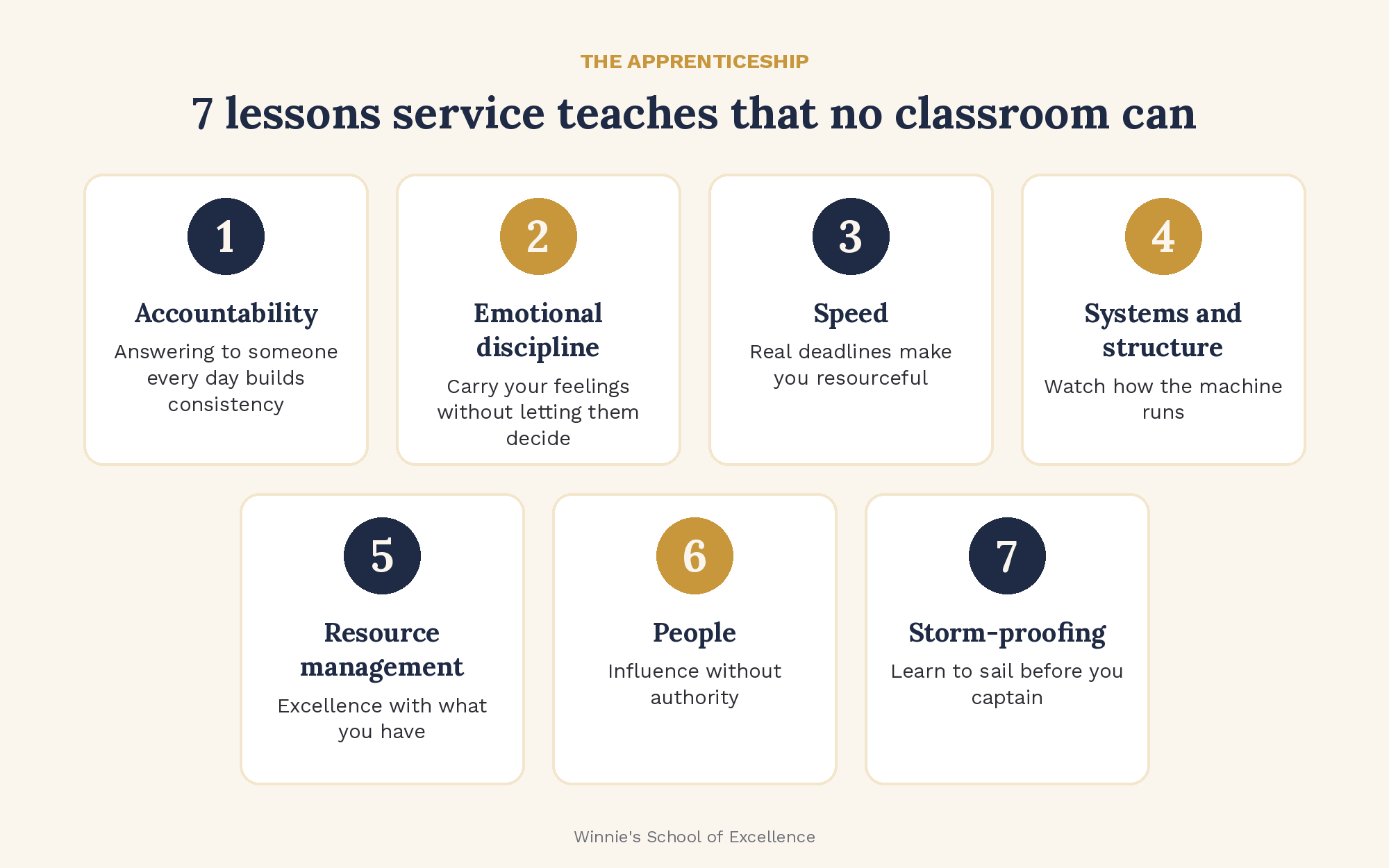
Serving in someone else’s organisation, whether at work, in church, in school or in your community, is that apprenticeship. Here are seven lessons it will teach you, if you let it.
Lesson 1: Accountability. The Programme You Did Not Know You Signed Up For
People pay coaches, join challenges and download apps just to have someone to answer to. But if you are serving in someone else’s organisation, you are already enrolled in one of the best accountability programmes in the world. You answer to your boss, your manager, your leader, your HR, your clients.
And that constraint is doing something to you. It compels you, forms you and shapes you into a person with such a strength of character that, if you were accountable to no one, you might not have had the fortitude to maintain. Inspiration gets you started. Accountability keeps you going. When you serve, you have to give an account every day, and that daily account trains a muscle that motivation alone never builds.
This is exactly what happened to Irene. The consistency she could not build alone was built through the daily reps of showing up for someone else’s vision. And once a habit is built, it does not stay at the office. It follows you home and into everything you are building.
What this means for you: Every day you show up at work when you would rather not, you are not only serving your employer. You are training the version of you who will one day show up for your own vision with no one watching, especially on days when you are discouraged and you really don’t want to show up.
Try this: For the next seven days, notice every moment you show up at work when you did not feel like it. Write it down. At the end of the week, read the list and ask: what would happen to my vision if I showed up for it the same way?
Lesson 2: Emotional Discipline. Fervent in Spirit, Steady in Mood
“Not slothful in business; fervent in spirit; serving the Lord” (Romans 12:11, KJV).
Notice how that verse holds two things together. Diligence in business, and fire in the spirit. Service teaches you to keep both burning even on days when your mood says otherwise.
In a workplace, the deadline does not move because you are upset. The client still needs to be served. The report is still due on Friday. And slowly, without even noticing, you learn to carry your feelings without letting them dictate your decisions.
What this means for you: Every leader will face days when they feel nothing but still have to lead. Service is where you practise for those days, even if the only person you’re leading is yourself. These actions helps you become a better leader of yourself.
Try this: The next time something upsets you during working hours, write it down in one sentence and set a time later that day to come back to it properly. Then return to your work. You are not ignoring the feeling. You are giving it an appointment so it doesn’t interfere with your focus.
Lesson 3: Speed. Real Deadlines Make You Resourceful
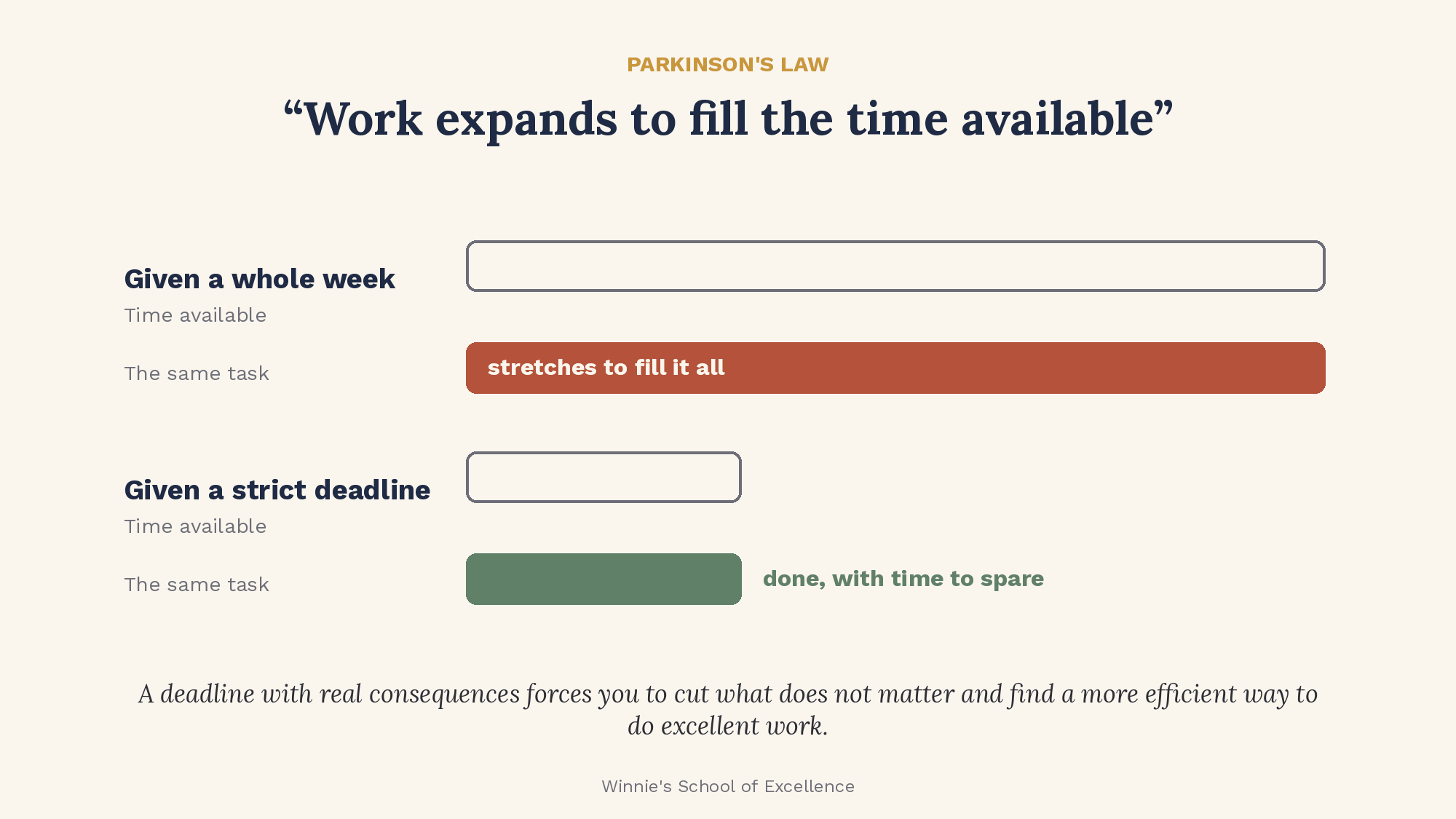
In 1955, the British historian C. Northcote Parkinson wrote an essay in The Economist that gave us an idea now known as Parkinson’s Law, which states that
“Work expands to fill the time available for its completion.”
Psychologists later tested it. In one well-known study, Elliot Aronson and David Landy found that people who were given more time than they needed for one task tended to take longer on the next task too, even when the extra time was no longer necessary. More time did not make them better. It made them slower.
That is why most successful people who seem to be involved in many things, such as running several successful ventures are usually very busy people. Oftentimes, you will find that they have the least time on their hands but achieve more in a day than most people who have more time on their hands. Because they have mastered the art of time, energy, and resource management.
A deadline with real consequences forces you to think creatively, cut out what does not matter and find a more efficient way to do excellent work.
So if your excuse for not working on your vision is that you do not have time, let me say this gently but honestly:
Very often, it is not a time problem. It is a seriousness problem and a commitment problem. You’ve already learned to deliver under pressure at work, I promise you, you can also find an hour for your vision. You just have to decide that it matters as much. and take off your employee hat and put on your boss hat to ensure that your goals and deliverables for your vision are met.
Try this: Pick one task in your vision that you have been “too busy” to do. Give it a deadline as strict as one your boss would set, with a real consequence attached, and see how quickly it gets done. Remember that you’re a leader of yourself.
Free Self-Reflection Journal
Your Hardest Days at Work Are Trying to Teach You Something
Most people carry the pressure home and never look at it again. The free Hindsight Journal helps you look at what you have been through with a new perspective, through an empowered lens. Write down what you went through, then discover what it taught you and how it changed you for the better. Type straight into it or print it out. A few quiet minutes could change how you see this entire season.
Lesson 4: Systems and Structure. Watch How the Machine Runs
Whether you serve inside an organisation that is doing something close to what you want to do or not, you get a front-row seat to how systems really work. You see how decisions are made. You see how individual teams are run towards the greater goal. You see what happens when a process breaks.
And you get to learn from mistakes that you did not have to pay for. A few months of careful observation can save you years of trial and error in your own venture.
What this means for you: If you have a big vision and you keep failing, losing hope or getting distracted, go and serve in an organisation that is doing something similar. Observe their systems, their structure, and their approach. You are getting a free education in the very thing you want to build.
Lesson 5: Resource Management. Excellence With What You Have
Resource management is a vital skill every great leader must learn. Not enough budget, not enough staff, not enough time. And yet the work still has to be done, and done well.
Serving under those conditions teaches you to stretch resources creatively. It teaches you to stop waiting for perfect conditions and to produce excellence with what is in your hands. And because the resources are not yours, it teaches you the discipline of a steward, which is the best training ground for the day the resources will be yours.
What this means for you: The person who has learned to be faithful with another man’s budget will not waste their own.
Try this: Think of one thing at work you have been saying you cannot do “because we do not have the resources.” Find one way to do it, even partially, with what is available right now.
Lesson 6: People. Learning to Work Across the Table

No one achieves a vision alone. And service is where you learn to work with people you did not choose: the colleague who is always late, the manager who communicates badly, the department that keeps missing its deadlines and holding up yours.
Working across those teams teaches you patience, communication, and influence without authority. You learn how to get things done with people, not just through them. These are the same skills you will need when the team is yours.
What this means for you: Every difficult colleague is a free lesson in people management. Pay attention to what frustrates you, because one day you will be responsible for making sure your own team does not feel the same way.
Try this: Think of the person at work you find hardest to deal with. Write down one thing they do that frustrates you and one thing you can learn from how others handle them well.
The Hindsight Journal
Feeling Taken for Granted? Turn It Into Proof
Whether it is a demanding boss, a colleague who tests your patience or a relationship where your giving goes unseen, what you have been carrying does not have to be wasted. The free Hindsight Journal helps you write it down honestly, find the lesson hidden inside it and see how it is changing you for the better. So when you look back on this season, you will not just remember the pressure. You will see what it built in you, and you will carry that strength into every other area of your life.
Lesson 7: Storm-Proofing. Learn to Sail Before You Captain
Think of it this way. When you are an officer on someone else’s ship and the ship rocks, you still feel the pressure. But you also get to watch how the captain handles it. You see how problems are solved, how decisions are made in a crisis, how the crew is held together. You brainstorm, you contribute, and you come up with ways to do things differently.
In that process, you get to be part of the storm and part of the peace that comes after it. And that builds the mental fortitude you will need when you are the captain of your own ship.
Service insulates you against the storms that come with leadership, because by the time you face them as a captain, you have already survived them as an officer.
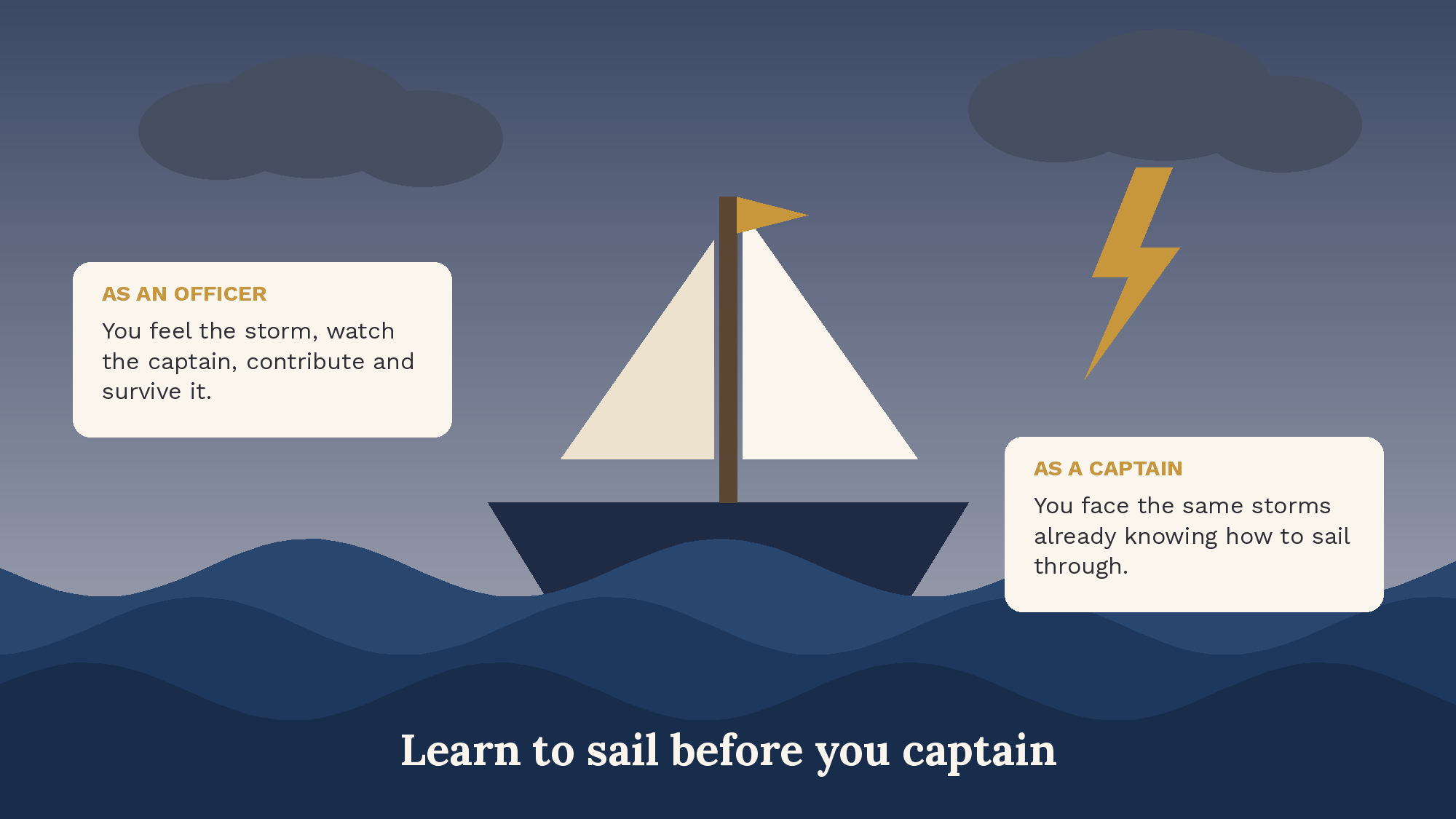
Try this: Think of the last crisis at your workplace. Write down how it was handled, what worked, what did not, and what you would have done differently if it were your ship.
Service Teaches You Self-reliance and Resilience
I want to share a powerful anecdote from one of the most successful serial entrepreneurs in history, Richard Branson. When Richard Branson was a young boy, his mother, Eve, stopped the car about three miles from home, let him out and told him to find his own way back. He did, asking strangers for directions along the way. Branson has said that lessons like that taught him to step outside his comfort zone, and helped him grow into one of the most fearless entrepreneurs of his generation.
As I thought about that story, I sensed the Holy Spirit whisper something to me: that is how the Lord leads us too.
Scripture describes Him like an eagle that “stirreth up her nest, fluttereth over her young, spreadeth abroad her wings, taketh them, beareth them on her wings” (Deuteronomy 32:11, KJV). He disturbs the comfortable nest so the wings already inside us can come out. But notice that He is also there to catch us.
Service is often the stirred nest. It is the three miles from home walk that Richard’s mom put him through. It is the place where nobody does it for you, and you discover strength you did not know you already had. I have so much more to say about this, and I will in a coming post.
The Reward of Service Is a Double Portion
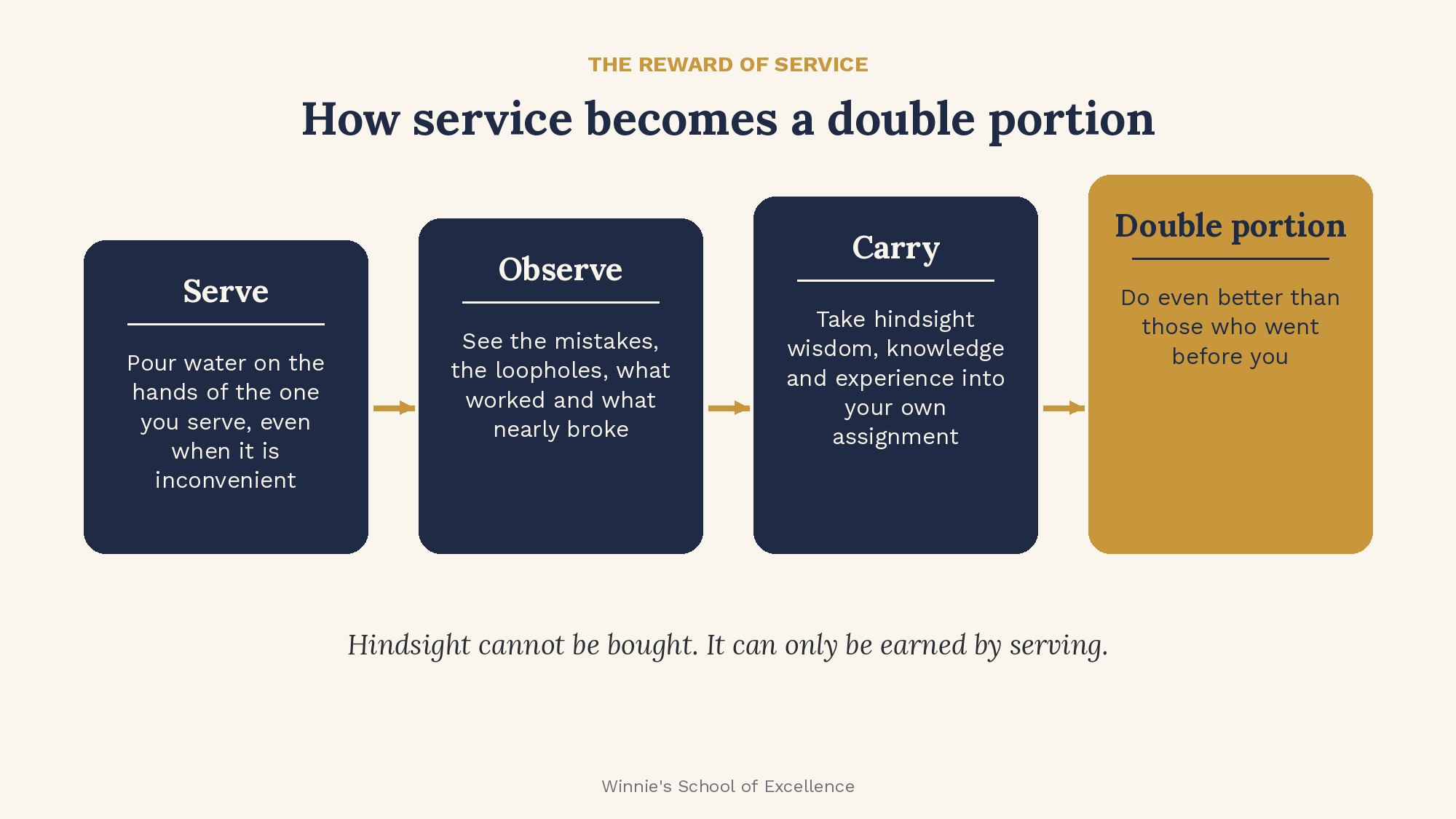
There is a man in scripture called Elisha who received a double portion of the anointing of his master Elijah. Elisha was able to receive this because he served. For a long time, he was known simply as the one “who poured water on the hands of Elijah” (2 Kings 3:11, KJV).
But it was in the place of service that he learned how to navigate the politics of the court and the allure of deceptive gifts.
He received a double portion by serving inspiteof Elijah’s iconic foul temper or the sheer inconvenience that may not be documented in scripture.
Here is the truth. If you master and embrace service, very often you will find that the reward may include a double portion of the same grace that rested on the person you served. Why?
Because you were there. You saw the mistakes. You saw the loopholes. You watched what worked and what nearly broke everything. And now you carry hindsight wisdom, knowledge and experience into your own assignment so you can do even better.
That hindsight is invaluable on the road to fulfilling your purpose and your destiny. You simply cannot buy it. You can only earn it by serving.
So Do Not Loathe Your Job. Learn From It.
I am not saying you cannot learn these lessons on your own. You most certainly can. What I want you to see is that serving other people’s visions, at work, in church, in school or wherever you are, is building you into a more competent person who is equipped for your own vision.
So instead of resenting where you are, ask yourself this:
“While I am building my vision, what has my current job taught me, and how can I embrace these lessons fully, so that long after the pressure is gone, I still carry them as habits in my life?”
That is what this season is doing to you and in you.
You Do Not Have to Do This Alone
Service can feel lonely, especially when the people around you are counting down to Friday while you are trying to treat your job as a classroom. You need people who see what you see and remind you why you are doing it.
That is exactly what the Excellence Elite community is for. It is a space where people who are serious about becoming who they were created to be hold each other accountable and keep each other growing.
And if you are not sure how your current job connects to your vision, book a Vision-to-Reality 1-on-1 Consultation and let us map it out together. Sometimes one conversation is all it takes to see the raw material you are already holding.
Go Deeper
If you are still unclear about your vision and purpose for your life, start with the Vision & Purpose Mastery Webinar.
If Lesson 6 hit home and expressing yourself in your working relationships is where you struggle most, The Art of Effective Speaking & Communication will help you communicate with clarity and influence, with or without a title.
I’ll see you in my next post!💖
Key Takeaways
- Service is a prerequisite of leadership. The title tells people where you sit. Service tells them whether you deserve the seat.
- Service is not being a doormat. It is identifying a gap your contribution can fill and holding it together so the organisation does not fall.
- Your current job is raw material for your vision: skills, network, industry insight and possibly your first clients.
- Pain is real and should be cared for, but destiny is not emotional. Your pain deserves care, not control.
- If you feel misaligned with your company, quitting is not the only option. You can be the leader you wish you had for the people around you.
- Service teaches seven lessons no classroom can: accountability, emotional discipline, speed, systems, resource management, people and storm-proofing.
- If you have not been faithful with what belongs to another, it is hard to be trusted with your own (Luke 16:12).
- The double portion goes to the one who refuses to quit. Service gives you hindsight wisdom that you carry into your own assignment.
Frequently Asked Questions
What if my job has nothing to do with my vision?
Every job teaches transferable skills. Even if the industry is completely different, you are still learning consistency, time management, people skills and how organisations run. Look past the job description and ask what the job is building in you. You may be surprised how much of it you will need.
My boss is difficult. Should I still give my best?
Yes, as long as you are choosing to stay. Your excellence is not a gift to your boss. It is an investment in who you are becoming. Serve “as to the Lord, and not unto men.” That said, service does not mean accepting abuse. If an environment is harmful, that is a different conversation, and it is wise to seek counsel.
Does this mean I should never leave my job?
Not at all. Seasons end. Elisha did not serve Elijah forever, and you will not serve in the same place forever either. The question is not whether you will leave. It is whether you will leave having learned everything that season was meant to teach you.
How do I serve wholeheartedly without being taken advantage of?
Serve from purpose, not from fear. Going the extra mile because you see a gap is service. Saying yes to everything because you are afraid of disapproval is not. Clear boundaries and wholehearted service can live together, and the best leaders model both.
I already run my own business. Does service still apply to me?
Absolutely. You serve your clients, your team and your community every day. You can also serve under a mentor, in your church or in an organisation whose systems you admire. The leaders who stop serving are usually the leaders who stop growing.
References
Selman, J. Teaching on service.
Greenleaf, R. K. (1970). The Servant as Leader. The Greenleaf Center for Servant Leadership.
Greene, R. (2012). Mastery. Viking.
Parkinson, C. N. (1955, November 19). “Parkinson’s Law.” The Economist.
Sinek, S. Interview with Emma Grede, Aspire with Emma Grede podcast.
Branson, R. “My mother’s unconventional parenting lessons.”
Scripture quotations from the King James Version (KJV): Deuteronomy 32:11; Ecclesiastes 9:10; Isaiah 30:21; Mark 10:43-44; Luke 16:12; Romans 12:11; Colossians 3:23; 1 Kings 19:19-21; 2 Kings 2:2-9; 2 Kings 3:11.
Recent Posts
-

Service: The Part of Leadership Nobody Wants to Talk About (and 7 Lessons It Teaches You!)
October 16, 2026 -

Self-Mastery: The First Attribute of Every Great Leader (and 10 Steps to Build It)
October 9, 2026 -

How to Create an Offer That Sells: Pricing, Packaging and Positioning Made Simple
October 2, 2026 -

How to Make Your Annual Income in a Month: The Wealth Mastery Skill Nobody Taught You
September 25, 2026 -

The Art of Effective Communication: 5 Communication Shifts That Will Transform How People Respond to You, Your Brand, and Your Value.
September 18, 2026