
 Winifred Nwania
₦1.5 Trillion in One Hour? Does Your “Wealthy” Have A Number?
On September 14, 2026, Aliko Dangote rang the opening gong at the Nigerian Exchange. The Dangote Petroleum Refinery IPO went live. ₦525 per share. And within the first hour, roughly ₦1.5 trillion had been subscribed.
Let that number sit with you for a moment.
WhatsApp groups are buzzing. Office conversations have turned into stock market debates. People who have never bought a single share in their lives are asking,
“How do I get in?” The whole country is talking about wealth.
But here is the uncomfortable question I want to ask you today. Of all the people rushing to invest in Dangote, how many of them can tell you, right now, how much money they want to have and by when?
Most people say they want to be wealthy. Ask them how much is “wealthy”, and the room goes quiet.
“I just want to be comfortable.”
“I want plenty money.”
“I want to live well.“
How much is plenty? Infinity? Compared to what? If you earn ₦1 million a month and your bills and responsibilities cost ₦900,000, you are not wealthy. You are surviving with a bigger salary.
The distance between you and wealth is not really effort. It is not necessarily even opportunity. Right now, opportunity is literally on the Nigerian Exchange at ₦525 a share. The distance between you and wealth is specificity. And that is where we begin today.
In my last post, I showed you why communication mastery is the skill that turns every other skill into opportunity. But the best communicators in the world can still go broke if they do not understand money. Today we tackle the skill that determines whether everything you have built actually sustains itself: financial mastery.
And if you’ve read “You Were Born Rich,” you already understand that: you were not born empty. You were born with talents, gifts, and a calling that this world needs and will pay for. Today we move from knowing you have a fortune in your hands to knowing exactly how to turn it into wealth.
Let us begin.
Wealth is A Number, Not Just A State of Being or Feeling

Nobody says Aliko Dangote is “very rich.” Bloomberg says his net worth is between $28 billion and $37 billion. Forbes publishes a figure. The Nigerian Exchange values his refinery at approximately $40 billion. There is always a number.
Evaluation firms, stock exchanges, financial institutions. None of them deal in vibes. They deal in figures.
But ask the average person what “wealthy” means for them and you get something that sounds more like a prayer than a plan:
“I just want God to bless me.”
“I want to be comfortable.”
“I want money not to be a problem.“
These are beautiful desires. But they are not financial targets. And you cannot hit a target you have never defined. The first wealth mastery skill is specificity.
So let me ask you directly: how much money do you want to have?
Define the number. Not “a lot.” Not “enough.” A figure. $1 million? $5 million? $20 million? Write it down.
Define the form. Do you want that number sitting in your bank account? In assets? In property? In stocks? In a business you own? Because $10 million in a savings account and $10 million in income-producing assets are two very different financial positions.
Define the timeline. By when? This year? In three years? In ten? Because the timeline changes everything about your strategy.
Once you set the number, something powerful happens. Your brain stops dreaming vaguely and starts solving in specifics. Instead of “I want to be wealthy,” you are now working with “I want $2 million in assets within three years.” That is a problem your mind can actually solve. That is a destination you can actually map a route to.
And here is the beautiful part: wealth creation was designed to be progressive. The moment you reach that $2 million in assets, you raise the bar to $10 million. When you reach $10 million, you set your sights on $50 million. The number keeps growing because you keep growing. But it has to start with a number. Not a vibe. Not abracadabra. A number.
Speed Matters: Why $1 Million Today Is Not $1 Million Tomorrow
Here is something most people never consider when they set their financial goals.
If you make $1 million today and someone else takes 49 years to make the same $1 million, you are not in the same financial position. Not even close. Because by the time that person gets there, inflation has been quietly eating the value of that money for five decades. The dollar they finally saved cannot buy what yours could buy the day you earned it.
Myron Golden, one of the most respected wealth coaches in the world, puts this so plainly that it stops you in your tracks: “It is easier to make a lot of money in a short period of time than it is to make a little money over a long period of time.”
That sounds counterintuitive. But think about it. Making a little money over a long time means trading hours for money, year after year, while the value quietly shrinks underneath you. You are running on a treadmill that is slowly speeding up. By the time you reach your “goal,” the finish line has moved.
Speed and timing are not luxuries. They are wealth strategies.
This is part of what makes the Dangote IPO significant beyond the headlines. Dangote did not build a $20 billion refinery by being patient in a passive way. He moved with speed and precision. From commodity trading in the 1970s to cement production in the 1990s to sugar and flour and fertilizer to the refinery that now has the capacity to refine 650,000 barrels of crude oil per day. Each move built on the last. Each one compounded.
And the IPO? That is the harvest of decades of a compounding track record. The question you need to ask yourself is:
How am I compounding my wealth right now?
Is my current strategy telling me that I’d have to be closer to the grave than I am now before I can call myself “wealthy”?
If the answer to the last question is yes, then you need to change your strategy
What Is Your Annual Income, Really?
Before we talk about making your annual income in a month, let us be honest about what your annual income actually is.

It is you. Doing a set of tasks, service or routines for someone or for yourself. Per hour, or Monday to Friday, or Monday to Sunday, depending on your situation. For however many working days you put in over 365 days.
That is it. You are repeating a unit of value, day after day, for a full year. The total of all those repetitions is what you call your “annual income.”
Now imagine if you could deliver a year’s worth of value in a single month. How much would you earn?
You would earn your annual income in a month.
“But Winnie, that’s impossible. I would need a hundred different jobs!“
No. You do not need a hundred different jobs because you do not have a hundred different hours! But you can still produce that result. Not by multiplying the hours you work, but by multiplying the sources that pay you.
The late Bob Proctor, who spent over 60 years studying wealth creation and coached millions of people on the subject, called this MSI: Multiple Sources of Income.
And it changed my understanding of money completely.
The Three Income Strategies: Which One Are You Using?
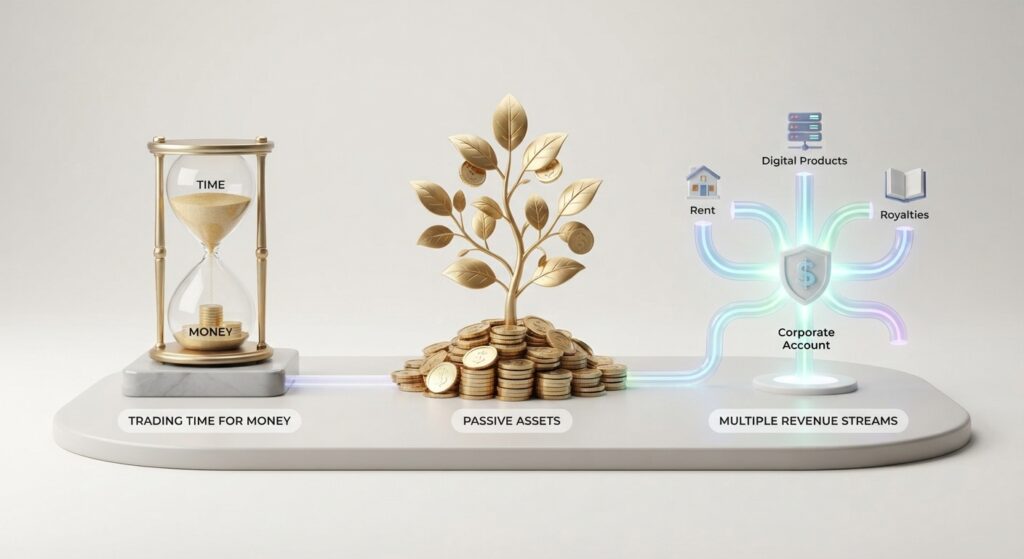
Bob Proctor studied a statistic that most people have heard but very few have actually thought about: 3% of the population earns 97% of all the money that is earned.
Everyone hears that and says it is unfair. But Proctor discovered that this doesn’t happen arbitrarily or by luck. It is not even about intelligence or education. Some of the 3% are functionally illiterate. Some of the 97% are absolutely brilliant. So what is the difference?
It comes down to which income strategy you are using. There are only three.
Strategy M1: Trade Time for Money
This is the 9-to-5. You show up, you work your hours, you get paid. 96% of the population uses this strategy.
The problem? There is a ceiling. You run out of time. There are only 24 hours in a day, and you can only trade so many of them before your body gives out.
Bob Proctor learned this the hard way. When he started his first business, a cleaning company, he thought the answer was to work harder. Get another office to clean. Then another. He pushed himself so hard that he literally collapsed on the street from exhaustion. Woke up with a police officer standing over him, people crowding around, lights flashing. He had passed out. And in that terrifying moment, something inside him said: “Bob, you are doing something wrong.”
Hard work was not the answer. And I want you to hear this, because many of us have been raised to believe that the cure for every financial problem is to “hustle harder”.
But Bob Proctor made a powerful observation: “The people you know who work the hardest are probably the ones who earn the least.”
Really think about that. Think about the hardest-working people in your life. Are they the wealthiest? Or are they the most exhausted?
M1 is not a bad strategy. It is a starting point. But if it is your only strategy, your earning potential will always be capped.
Strategy M2: Invest Money to Earn Money
This is where stocks, real estate, and assets come in. You put money into vehicles that grow it. Only about 3% of the population uses this strategy effectively.
The Dangote IPO is an M2 opportunity. You invest ₦525 per share into a company with a track record and the potential for growth. If the value of those shares increases over time, your money has earned money. That is M2.
But M2 requires something most people skip: financial literacy. You need to understand what you are investing in, why, and what the risks are. Investing without knowledge is not investing. It is gambling with good intentions.
This is exactly why the next masterclass, Masterclass with Winnie 2.0 will be on Financial empowerment. Where I would be inviting reputable wealth coaches and financial experts to teach you how to create generational wealth. This masterclass will give you the operational knowledge you need to make financial decisions with confidence, not guesswork.
If you would like to attend this masterclass, click here to join our waitlist
Strategy M3: Multiple Sources of Income
This is the strategy of the 1%, and when you understand it, everything changes.
After Proctor collapsed on the street, he did not go back to cleaning more offices himself. He got off by himself and started to think. And then a thought came to him that redirected his entire life:
“If you cannot clean all of them, do not clean any of them.”
Over the next five years, he set up cleaning operations in Toronto, Montreal, Boston, Cleveland, Atlanta, and London. Income started flowing in from multiple cities. He was no longer trading his time for money. He had set up systems that produced value and collected income whether he was physically present or not.
It took him ten years to understand what he had done differently. He did not have one source of income. He had many. And that single shift took his income past a million.
The 1% multiply their time by setting up multiple sources of income. Some of those sources will be big. Some will be small. Some will not even work, and that’s okay because you’ll learn from it. But they all have one thing in common: they all flow into your account. And over time, the combined flow becomes something your single salary could never match.
You may be thinking:
“Winnie, that sounds amazing, but I do not know how to do that.” Good. Because Proctor said something that I want you to hold onto:
“You do not have to know how. You just have to make a decision that you are going to do it. When you make the decision, you will start to attract the how.”
Stop Reading About Wealth. Start Planning It.
You have just learned the three income strategies and taken inventory of what is already in your hands. Now turn that knowledge into a real plan. This free editable worksheet walks you through all 7 steps with prompts designed to help you brainstorm, get specific, and map your personal path from one income source to many.
The Income Vehicle Trap: Are You Pouring Energy Into the Wrong Thing?
Before I give you the 7-step blueprint, there is a very subtle trap that most brilliant, hardworking people fall into. And if you’re not careful, you’re probably right at the center of this trap.
25-year-old Isabelle Lorna, in the UK built a social media marketing agency from scratch. No degree, no corporate pedigree. By her early twenties, the agency was earning £30,000 to £40,000 per month. Which was quite a decent amount of revenue compared to her last job.
But she also had a personal brand as an influencer. And here is what she discovered: a single piece of content she posted could earn her the same fee that took an entire month of agency work to generate.
She was putting 50% of her energy into the lower-returning vehicle and 50% into the higher-returning one. When she finally dissolved the agency, she described the feeling as “coming up for air.”
She said something that you should consider: “I should have done this a year ago, but it felt like failure. I had to reframe it in my brain as a change of effort. Instead of putting the time into that, I am putting it into my other projects. And it is an investment. I am reinvesting the time in a better way.“
The lesson here is not about influencing or marketing agencies. The lesson is this:
If you are pouring your best energy into the income vehicle that pays you the least per unit of effort, you are working hard in the wrong direction.
Unless you’re actively trying to start a new venture and you’re still going through the early stages of growth, if not, this is your sign to redirect your time, focus, and energy to your best income generator.
The question is never “how do I work harder?” Instead, you should be asking yourself: which of my income generators returns the most for the energy I put in, and how do I build more of those?
This is where personal branding becomes a financial strategy, not just a visibility game. Your brand is what allows you to charge a premium for the same skill that someone else is undercharging for. If you have not read my earlier post on personal branding, I encourage you to go back to it, because understanding your brand’s value is directly connected to how much money you can command. And the Art of Personal Branding course is designed to help you build that positioning strategically.
The 7-Step Wealth Mastery Blueprint: How to Make Your Annual Income in a Month
Here is the framework. It is simple. But do not confuse simple with easy. Every wealthy person I have studied, every mentor I have learned from, and every case study I have observed follows some version of these seven steps. The difference is whether you will actually do them.
Step 1: Decide on Your Number and Make Up Your Mind

How much money do you want to have? Not “I want to be wealthy.” How much? In what form? By when?
And then make up your mind, firmly and irreversibly, that you are going to make your annual income in a month. You do not need to know how. You just need to decide. The how will come to you. This is not wishful thinking. This is what every wealthy person from Proctor to Dangote did in different ways:
The decision comes first. The strategy follows.
Write your number down. Put it where you can see it every day. Then become the type of person who can make that amount.
Every time your mind tells you it is impossible, remind yourself that every day you are choosing to be the kind of person who makes that amount: in your thinking, habits, discipline, decision making, opportunities you see and seize, relationships you maintain and leverage. Every day you are becoming.
Step 2: Take Inventory of What Is Already in Your Hands
In “You Were Born Rich,” I used the Parable of the Talents to show you that nobody was born empty. Every person on this earth was given gifts, strengths, curiosities, and callings that this world needs. Your talent is your capital.
So take an inventory of your skills and abilities right now. What do you already have?
Do you like talking? Cooking? Reading? Writing? Are you creative? Do you enjoy homemaking? Baking? Are you the person who is always asking questions, always curious about how things work?
Write it all down. Do not filter. Do not judge. Do not say “but that is not a real skill.” Just take an inventory of everything that you do naturally, everything people compliment you on, everything that feels almost too easy.
That list is your raw material.
Step 3: Stop Underestimating Yourself. Refine It and Package It.
This is where most people get stuck. They look at their raw material and think it is not enough. Every raw material you have can be refined into something valuable. Every single one.
You like talking? That can become: compère, podcast host, voice-over artist, motivational speaker, corporate MC, coach, trainer, event host.
You like reading? That can become: educator (online or offline), course creator, book reviewer, research consultant, content strategist.
You like writing? That can become: blog, ghostwriting, book authorship, copywriting, content creation, scriptwriting, grant writing.
You are creative? That can become: art, design, content creation, styling, photography, brand identity, event design.
You love asking questions? That can become: interviewer, journalist, researcher, community builder, someone who discovers answers to the burning questions everyone else is asking and packages those answers into value.
The point is this: what you think is “just something I do” is actually a skill that someone, somewhere, will pay for. The gap between your raw material and a source of income is refinement and packaging.
And this is exactly what our Art of Effective Speaking and Communication course teaches you to do with your voice, and what the Art of Personal Branding course teaches you to do with your positioning. The same skill, refined and packaged differently, commands a completely different price.
Step 4: Create an Offer
Once you have refined your skill, you turn it into something people can exchange money for. An offer. A service. A product. A package. Something with a clear outcome that solves a real problem or fills a genuine need.
Remember Proctor’s Law of Compensation: your income is in direct ratio to:
- The need for what you do
- Your ability to do it
- And the difficulty there is in replacing you.
If you find a massive need, develop an excellent ability to fill it, and become difficult to replace, you will earn a fortune. That is not a motivational quote. That is a law.
In my next post, I am giving you a crash course on exactly how to create an offer that sells. We will go deep on pricing, packaging, and positioning your offer so that the right people see it and say yes. Stay tuned for that one. But for now, know that your offer is the bridge between your skill and your income.
Step 5: Develop Your Personal Brand as You Sell
Do not wait until your brand is “ready” before you start selling. Your brand and your offer grow together. You build your brand, the brand sells, and the selling builds the brand. You show up, and the showing up attracts more people to sell to. I talk more about this here
In essence, your skill development gives you competence. Your personal branding gives you visibility. Your communication mastery gives you the ability to make people connect with you and what you have to offer. And now, your financial mastery gives you the vehicle to turn all of that into income.
If you’re still struggling to build a powerful personal brand that commands premium fees, the Art of Personal Branding course walks you through it step by step. And Style Up Girl! helps you ensure that the visual impression you make matches the premium value you deliver. Because the way you present yourself is part of what determines what you can charge.
Step 6: Improve Your Offer and Sell to More People

Your first offer will not be perfect. It does not need to be. What it needs to be is out there, in front of real people, generating real feedback.
Listen to what your customers tell you. What did they love? What confused them? What did they wish was included? Use that feedback to improve. Then raise the price and widen your reach.
Every iteration makes your offer stronger, your reputation more credible, and your ability to command a premium higher. You do not get wealthy by accident. You get wealthy by getting better, consistently, at delivering value. And don’t forget to grow your skills and expertise as you refine and improve your offer.
Step 7: Reap the Compound Interest of a Solid Brand, a Great Product, and Referrals
This is where the M3 magic kicks in.
Once your personal brand is established, your product is proven, and your customers start referring others, income begins to multiply without you multiplying your hours. You are no longer chasing every sale. People are finding you. Opportunities are coming to you. Your reputation arrives before you do.
Bob Proctor used a beautiful analogy. He described watching a performer in a nightclub spinning 18 plates on bamboo poles simultaneously. His friend marvelled at how well the man spun the plates. Proctor’s response was: the remarkable thing is not how well he does it, but that he does it at all. And then he asked the question that you too should sit with:
“How do you become an 18-plate spinner?”
You start by learning to spin one. You master that one plate. Then you add another. Then another. And before you know it, you have multiple sources of income all spinning, all flowing, all feeding into the same account.
You can use this affirmation Proctor used. It’s my gift to you because it will change how your mindset perceives abundance:
“I am so happy and grateful now that money comes to me in increasing quantities through multiple sources on a continuous basis.”
That is not just a nice sentence to repeat. That is a state of being and a mindset that opens your eyes to see opportunities where people overlook and attracts abundance to your life.
You Have the Blueprint. Now Build the Plan.
You have just read the 7 steps. But reading a blueprint and building from it are two different things. This free editable worksheet gives you the prompts to turn each step into your own personal wealth strategy. Define your number. Take inventory of your skills. Map your first multiple income sources. Do not let this post become something you bookmarked and forgot.
Get Really Good at The Skill You Choose to Master
I want to be very clear about something. When I say “get really good,” I do not necessarily mean get really good at your job. Especially if it is not a job you enjoy.
I mean get really good at the skill you have decided to master. The one you identified in Step 2. The one you refined in Step 3. The one you turned into an offer in Step 4. That is what deserves your obsessive focus.
When you become excellent at something the world needs, you stop competing on price. You start being sought after. People come to you. They pay what you ask. And they bring others.
Proctor himself worked with Earl Nightingale and Lloyd Conant, two of the greatest minds in personal development. He did not just admire them from a distance, he studied how they worked, attained mastery. And then he became one of the most difficult people to replace in his industry. That is what mastery earns you.
Back to the Mirror: How are You Compounding Your Wealth?

Dangote did not start with a refinery. He started in the 1970s, trading commodities from his uncle’s warehouse. He took inventory of what was in his hands. He refined it. He packaged it. He created offer after offer. Cement. Sugar. Flour. Fertilizer. He built a brand that an entire continent trusts.
And now, more than four decades of a stellar track record, the Dangote refinery IPO gives every Nigerian the chance to own a piece of what he built.
The question is not whether you should buy Dangote’s shares or not.
The real question is what wealth strategy are you using to change your earning potential within 1 year? What about 5 years? What about for a generation?
How are you compounding your wealth?
Are you creating something that creates value? Something that somebody, someday, might want to invest in?
Take inventory of the skills and abilities you currently have. Package what is in your hands. Build your offer. Build your brand. And let the compound interest of excellence do what it was always designed to do: generate income.
Because the next time someone asks you “how much wealth do you want to have?”
I do not want you to say “I just want to be comfortable.” I want you to give them a number. Your number. With a date attached, and that date starts right now.
You Do Not Have to Build This Alone
Setting a wealth goal is one thing. Staying accountable to it while the world pulls you in every direction is another. The Excellence Elite community is where people building every skill in this series come together to practise, get feedback, and hold each other accountable.
This month of September is our Financial Stewardship month where we’ll be talking about wealth consciousness, money mindset, income & value creation, financial discipline, and lots more! If you haven’t joined the Excellence Elite community, click here to join us today and become part of the money conversations in my inner circle.
And if your financial situation is specific, if you need someone to sit with you and help you evaluate your current income vehicles, and build a personalised plan, sign up for a Vision-to-Reality 1-on-1 Consultation where I will help you create a strategy tailored to your exact situation and goals.
Coming Next: How to Create an Offer That Sells
You can have all the talent in the world. You can refine it, package it, and build a brand around it. But if you do not know how to turn it into an offer that people can say yes to, you will stay talented and broke.
In my next post, I am giving you the crash course I wish someone gave me years ago: how to create an offer that sells. We are going to cover pricing, packaging, positioning, and the psychology of why people buy. Whether you are creating your first offer or fixing one that is not converting, that post is for you.
I will see you there!💖
Key Takeaways
- Wealth is a number, not a feeling. Define how much, in what form, and by when. You cannot hit a target you have never set.
- Speed matters in wealth creation. ₦1 million today and ₦1 million in 49 years are not the same, because inflation erodes value over time. Move with intention and urgency.
- Your annual income is a year of repeated value. If you could deliver that value in a month through multiple sources, you would earn your annual income in a month.
- There are three income strategies: M1 (trade time for money, used by 96%), M2 (invest money, used by 3%), and M3 (multiple sources of income, used by the 1%). Your goal is to move toward M3.
- The 7-Step Wealth Mastery Blueprint: decide on your number, take inventory, refine and package, create an offer, build your brand as you sell, improve and sell to more, and reap the compound interest of brand plus product plus referrals.
- Get really good at the skill you chose, not necessarily your job. Your income is in direct ratio to the need for what you do, your ability, and how hard you are to replace.
- Dangote started trading commodities from his uncle’s warehouse. Decades of compounding mastery later, the whole country wants to own a piece of what he built. Start building your own compound
FAQ
I do not have any money to invest. Does this apply to me?
Absolutely. M2 (investing money) is only one of the three strategies. M3 (multiple sources of income) does not require capital to start. It requires a decision, an inventory of your skills, and a willingness to package and sell them. Many of the most successful MSIs start with nothing more than a phone and a skill.
How do I know which skill to refine and package?
Start with what people already compliment you on. Not what you work hardest at. The things that feel almost too easy, the things where people say “how do you do that?” and you genuinely do not understand why they are asking. That is usually your highest-value raw material.
Is the Dangote IPO a good investment?
I am not a financial adviser and this post is not investment advice. What I can tell you is that every investment decision should be made from a place of financial literacy, not hype. Understand what you are buying, why, and what the risks are. If you need to build that literacy, the Financial Empowerment course by Sola Adesakin on our platform is a strong place to begin.
How long will it take to make my annual income in a month?
That depends on where you start, how quickly you refine your skill, and how many MSIs you build. Bob Proctor’s income crossed a million within a few years of shifting to the M3 strategy, but it took him a decade to understand what he had done differently. The good news is you do not have to wait a decade, because you are learning the framework now. Start with one MSI. Learn to spin one plate. Then add more.
I already have a good salary. Why do I need multiple sources of income?
A good salary is M1. It is capped by time. If you stop working, the income stops. MSIs protect you from that vulnerability and accelerate your wealth creation beyond what any single salary can offer. The wealthiest people in history, from the ancient Babylonians to today’s billionaires, have always had multiple sources of income. A good salary is a starting point, not a destination.
References
Proctor, B. “Increasing Your Income.” Proctor Gallagher Institute. Video lecture. https://www.proctorgallagherinstitute.com
Golden, M. “It’s Easier to Make a Lot of Money in a Short Period of Time.” Quote of the Day Show, Episode 1823. December 2023.
Daba Finance. “Dangote Refinery IPO: Status, Price and Date.” Verified tracker. Last verified 15 September 2026. https://dabafinance.com/en/dangote-ipo
Dangote Industries Limited. “Dangote Refinery Secures $1 Billion Backing Ahead of Planned IPO.” Press release, 18 August 2026. https://www.dangote.com
Dangote Petroleum Refinery. “The IPO for the People.” Official IPO website. https://ipo.dangote.com
Lorna, I. Appearance on Hot Smart Rich podcast, 2026.
Carnegie, D. (1936). How to Win Friends and Influence People. Simon & Schuster.
Proctor, B. (1984). You Were Born Rich. LifeSuccess Productions.
Recent Posts
-

How to Create an Offer That Sells: Pricing, Packaging and Positioning Made Simple
October 2, 2026 -

How to Make Your Annual Income in a Month: The Wealth Mastery Skill Nobody Taught You
September 25, 2026 -

The Art of Effective Communication: 5 Communication Shifts That Will Transform How People Respond to You, Your Brand, and Your Value.
September 18, 2026 -

What Is Your Personal Brand Telling People About You?
September 11, 2026 -

Your Growth is Not Optional: Why Skill Development is Your Best Offensive Weapon
September 4, 2026