
 Winifred Nwania
She Was Told to Talk Less. Now the World Pays to Listen

There is a woman in Nigeria whose school report cards came home with the same comment every single year:
“She could have come first if she talked less.”
Her sister beat her over those reports. Her teachers treated her voice like a problem to be managed. Everyone around her sent the same message: you are too much. Tone it down. Be quieter.
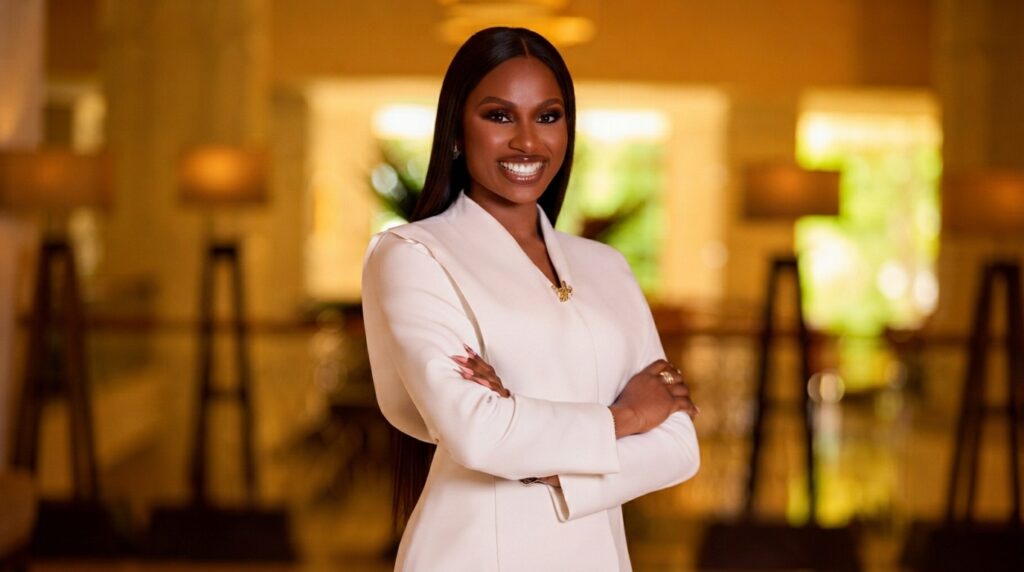
Her name is Mojibade Sosanya. And today, some of the most powerful institutions in Nigeria, presidents, governors, multinational corporations, and global trade forums, pay her premium fees to do exactly what everyone told her to stop doing: talk.
She is one of Nigeria’s most sought-after event hosts and my very own sugar girl! known as “The Lady MC.” She has held rooms for presidents, governors, hosted for Flutterwave and the IATF international trade forum, delivered two TEDx talks, and built a career that did not exist on any career guidance list when she was growing up.
But here is the part I want you to sit with, because this is not a story about becoming a compère. This is a story about what happens when you master the one skill that determines whether your purpose, your brand, your expertise, and your value actually reach the people they were meant for.
That skill is communication.
And if you have been showing up consistently, building your personal brand, creating content, putting yourself out there, but the results are not matching the effort, if the right audience is not finding you, if the opportunities are not converting, if people see you but do not feel compelled to stay, invest, or say yes, the problem might not be your visibility. It might be how you are communicating when you show up.
In my last post, I showed you why personal branding is the mastery skill that determines your wealth. But a personal brand without communication mastery is a beautiful storefront with a mute shopkeeper inside. People walk in, look around, and leave because nobody made them feel anything.
Today, I want to give you five communication shifts drawn from Mojibade’s journey and from some of the most powerful communication research available, that will change not just how you speak, but how people experience you. Whether you are on a stage, on a Zoom call, behind a camera, in a boardroom, or in someone’s DMs, these five shifts will determine whether people scroll past you or stop, whether they listen politely or lean in, and whether they say “that was nice” or “how do I work with you?”
I wrote about the foundations of effective communication and how to speak eloquently in earlier posts. Today, we go much deeper.
Let us begin.
Shift 1: Stop Speaking From Your Perspective. Start Speaking From Theirs.

This is the communication mistake that costs people the most, and almost nobody realises they are making it.
Communication expert Vinh Giang, who has spent over a decade training more than 100,000 professionals worldwide, shares a story from Dale Carnegie’s classic How to Win Friends and Influence People that illustrates this perfectly.
Vinh loved strawberries and cream. But when he went fishing, did he put strawberries and cream on the hook? Of course not. Because the fish does not care what Vinh likes for dessert. The fish want worms!
It sounds obvious. But Vinh realised he was making the exact same mistake with his own wife. He loves camping. So when he tried to convince her to go, he sold it using everything that excited him:
“Imagine, we are out in the wilderness, there are no bathrooms, we will have to dig holes, cut wood, make our own fire, and survive!“
He got more excited with every sentence. Meanwhile, his wife was looking at him like he was describing a hostage situation.
The problem was not camping. The problem was that he was explaining it entirely from his own perspective. If he had started with what motivated her: quality time with the family, disconnecting from devices, watching the children explore nature, it would have been the same camping trip but a completely different conversation.
Most people communicate from the inside out. They start with what they know, what they care about, what excites them and that’s great. But effective communication starts from the outside in. It starts with what the other person genuinely cares about and needs to hear.
Now watch how this played out in Mojibade’s career.
Mojibade shares that when she hosts an event, she does not show up with a script about what she wants to say. She shows up having studied the audience’s world. For a mining industry event she knew absolutely nothing about, she recorded the entire pre-event briefing call, listened to it multiple times, researched the terminology, studied the key players, and prepared so thoroughly that attendees came up to her afterward and asked, “How do you know so much about this industry?“
The key was effective communication. The ability to not just state facts, sounding like a dictionary because you researched, but to creatively craft a compelling story using the knowledge you’ve gained from research. She wasn’t part of the mining industry. But she knew how to make them feel that she understood their world. That is the difference between a communicator who performs AT a room and one who connects WITH it.
What this means for you:
If you are creating content for your personal brand, ask yourself:
Am I speaking from my perspective or theirs?
Or am I presenting my perspective in a way that will resonate with someone’s own story?
Am I leading with what excites me about my expertise, or am I leading with the problem they are lying awake at night trying to solve?
If you are pitching a service, ask:
Am I describing what I do, or am I describing what changes for them when I do it?
If you are showing up on camera and “just being yourself,” ask:
Is this version of myself serving them, or is it just comfortable for me?
The fish wants worms. Give them worms not strawberries & cream
Shift 2: Build Warmth Before You Build Competence.

Have you ever noticed that some people can be incredibly talented and brilliant at what they do, and yet people still do not connect with them?
Vanessa Van Edwards, behavioural researcher and author of Cues, discovered the answer through years of studying human behaviour. She found that when we meet someone, our brain unconsciously evaluates two things:
Warmth: Can I trust this person?
Competence: Can I rely on this person?
The people we call “charismatic,” the ones who seem to effortlessly hold attention, win trust, and open doors, they give cues of both. But most people only develop one side.
Vinh Giang experienced this firsthand. As a professional magician, he was technically brilliant. He would spend hours perfecting a single sleight-of-hand move that most people would not even notice. His competence was undeniable.
But when he performed for people, he was cold. Intense. Serious. He would look at them and say, “Watch. Watch. Watch.” He was performing AT people, not WITH them. He had developed the competence side of the equation and completely neglected warmth.
When he finally started learning showmanship, storytelling, playfulness, and how to use his voice and body to make people feel something, everything changed because he made people feel more connected.
Now look at Mojibade.
At Access Bank, she was a competent banker. She handled credit risk, client management, and analytics. But that is not what made people call her from the seventh floor to the fifth floor. That is not what made her “the go-to girl” within four months of joining.
What made her the go-to girl was this: within four months, despite promising herself she would stay invisible, she volunteered to coordinate a senior manager’s birthday celebration. Using effective communication skills, she made them feel connected in a way they had never felt before at a public function. And from that day, every department wanted her.
She did not earn that reputation through her perfect diction or robust vocabulary which you may boast of. She earned it through the grace and dexterity she exuded in her communication. Her competence was undeniable, but her communication skills, presence, grace, and poise opened the doors to even greater rooms
What this means for your personal brand:
On social media, competence without effective communication skills makes you sound like a textbook. Your posts are informative but forgettable. Your videos are correct but cold. People respect your knowledge, but they do not feel drawn to you.
Effective communication skills without competence makes you likeable but lightweight. People enjoy your energy, but they do not take you seriously enough to invest in you or hire you.
You need both. Your content needs to demonstrate that you know what you are talking about AND make people feel safe, seen, and understood. This is the difference between a personal brand that gets followers and one that gets clients.
And here is another thing most people often dismiss. Your trust cues start before you open your mouth. Your posture, your facial expression, your energy, the way you dress, the way you carry yourself, these are all signals. The room reads them before it hears you speak.
This is what Style Up Girl was designed to help you master, because your visual presentation is the opening sentence of your communication. If that sentence says “cold,” “unapproachable,” or “I did not prepare,” your words have to fight uphill from the very first moment you open your mouth.
Mojibade understands this intuitively: Your visual presentation greatly enhances how your words are received and felt. She once changed her entire hairstyle to a bob because one client almost did not hire her for touching her hair too much on stage. One distracting habit was undermining her competence. She caught it and corrected it because she understands that every visible detail matters in effective communication. You’ll learn more about body language in the Art of Effective Communication.
Download the Free 5-Shift Communication Checklist
Before your next post, video, or pitch goes live, run it through these five shifts. This printable checklist gives you the exact prompts to make sure every piece of content you create connects, converts, and stays with people long after they scroll past.
Shift 3: Stop Believing Your Voice Is Who You Are. It Is What You Have Been Practising.
This shift might be the most liberating thing you read today.
Vinh Giang says something that most people have never considered: “Your present voice is a learned voice.”

What you think is your “natural” way of speaking, your tone, your pace, your volume, your confidence or lack of it, none of it is fixed. All of it was absorbed. You learned how to communicate by watching the people around you as a child. Your parents, your teachers, your friends, the television you watched. You mimicked their patterns, adopted their habits, inherited their limitations. And then you called the result “just who I am.”
But it is not who you are. It is who you learned to be.
Vinh illustrates this powerfully through a student of his, a doctor. She was incredibly intelligent, genuinely capable. But she came to him and said, “The men in my industry never take me seriously.”
Gender bias is real. But when he listened to how she communicated, something else was happening that was within her control. Every statement she made sounded like a question. Her pitch rose at the end of her sentences. “I think we should move forward?” “I believe this is the right approach?” The words said “I am certain,” but the voice said “Am I?”
Vanessa Van Edwards calls this “upspeak”, and it is one of the most common cues that erodes perceived authority. It makes competent people sound unsure of their own competence.
When she worked on bringing her pitch down at the end of her statements. Swapping “I think” and “I feel like” for “I believe.” The difference was immediate. She was not more intelligent. She was already intelligent. All she did was adjust a few small cues, and suddenly she came across with the authority her expertise deserved.
Vinh also adds this profound statement that will stop you in your tracks:
“If you practice sounding unsure, then uncertainty is going to feel like your natural voice. Eventually you will say, ‘That is just who I am. I am an uncertain person.’ But what if that is not your identity? What if it is just your rehearsal history?”
Your current communication style is not a life sentence. It is a rehearsal history. And a different rehearsal produces a different communicator.
Now think about Mojibade.
Her childhood rehearsal environment punished her voice. “She could have come first if she talked less,” was the remark her school made about her. Her family, her teachers, everyone rehearsed her toward silence. They told her that her voice was a problem.
But she kept rehearsing anyway. She kept gathering children on her street and teaching them English. She kept hosting events. She kept volunteering to take the microphone. She was honing her communication skills even when the world had told her, her voice was “too much”, until that voice became the very thing that made her unforgettable in the hearts of people.
Years later, her sister called to apologise for beating her over those school reports. Because the effective communication skills she took time to master was now exactly what was paying the bills.
What this means for you:
The way you currently show up on camera, in meetings, in conversations, in pitches, that is not “just who you are.” It is what you have been practising. And anything that was practised can be practised differently.
If you sound unsure when you speak about your expertise, that is not a personality trait. It is a rehearsal history. If you freeze when someone asks you a hard question, that is not a character flaw. It is a lack of practice in that specific scenario. If you struggle to articulate your value, that is not because you lack value. It is because you have not yet rehearsed the language of your worth.
This is exactly what the Art of Effective Speaking and Communication is designed to help you do: not change who you are, but expand the range of how you express who you already are and to take you from being perceived as just competent to unforgettable and sought after.
Shift 4: Listen to Discover, Not to Solve.
Most people think great communicators are great talkers. True they do possess exceptional dexterity in articulating their ideas but effective communication is so much more than just “talking”.
Great communicators are great listeners.
If your default mode is “listen to solve.” When someone tells you a problem, the first thing you do is to already start building a 7-step action plan in your head. They did not ask you for the action plan, but you made them one anyway.
Or you respond by matching and “one-upping” their stories! They tell you they’re tired, and your brain immediately goes: “You think you are tired? I have two kids, two businesses, career crisis, family crisis, rent issues… on and on just to show that you’re going through “worse”
Both habits do the same thing: they make the conversation about you before the other person has finished telling their story.
Expert communicator Vinh, shares a powerful example of this: A student came to him and said, “I need to sound more confident in meetings.” His communication-teacher brain immediately wanted to fix it: Volume, rate of speech, body language, done. Easy!
But when he resisted the urge to solve and asked a few more questions, the real problem was completely different:
Maybe a senior team member constantly interrupts her.
Maybe she knows her subject perfectly but goes blank the moment she is challenged.
Maybe she is not struggling to speak at all. Maybe she is terrified of being wrong.
If he solved the first sentence she gave him, he might have solved the wrong thing.
His rule now: before you give the advice, before you share your thoughts or solution or even your version of the story someone is sharing with you, ask three more follow-up questions.
“Tell me more about what happened.”
“How did that make you feel?”
“Is there anything else?”

Stay in their world for three questions longer. Because once they know you care, they are much more likely to listen when you do share your perspective.
Mojibade lives this.
She does not just show up to events with a generic script. She prepares Google Sheets for weddings with every detail: the chairman’s relationship with the family, the couple’s story, the cultural sensitivities, the order of events. She does not do this because she has to. She does it because she understands that the person in front of her has a world, and her job is to enter it before she tries to lead it.
That is why people feel captivated when she hosts. Not just entertained. There is a difference, and the difference is listening. In the Art of Effective Speaking & Communication, you’ll learn frameworks that explain this in more details
What this means for your brand and your career:
As you build your personal brand, are you listening to your audience or broadcasting to them? The brands that grow fastest are not the ones that post the most. They are the ones that make people feel heard.
When you create content, are you speaking to their actual struggle, the thing keeping them up at night, or are you speaking to the problem you assume they have? Those are often very different things.
When someone reaches out to you for your service, do you immediately pitch, or do you ask three more questions to step into their world to understand their unique problem better?
The answers to those questions will tell you what they actually need. And when you solve the right problem, they do not just hire you once. They hire you again and come back with everyone they know.
Shift 5: Remember That Communication Always Goes in Two Directions.
This is the shift that separates good communicators from true master communicators.
Vinh Giang, drawing again from Vanessa Van Edwards’ research, makes a point that most people never think about: communication is not just about the cues you are sending. It is also about the cues you are receiving.

Most people are so busy thinking about what they are going to say next that they have no brain power left to pay attention to what the other person is actually telling them. Not with their words. With their face, their posture, their eyes, their energy.
Vanessa talks about the Duchenne smile, a genuine smile that reaches the cheeks and shows up around the eyes. It is different from a polite smile, which stays at the mouth. A genuine smile tells you the person is with you. A polite smile tells you they are being patient with you. If you cannot tell the difference, you are flying blind in every conversation.
Vinh also shares something profound about the importance of practicing effective communication skills:
The reason we practice our voice, our body language, and storytelling is not so we become obsessed with technique forever. It is so we can practice the skill until the skill needs less of our brain power, so we have more brain power available for people.
In other words: mastering effective communication skills frees you to be fully present. When you are no longer worried about how you sound, how you look, what to do with your hands, you can finally see the person in front of you. And that is when real connection happens.
Mojibade does this instinctively.
She once talked about the difference between knowing when to raise your voice and when to lower it. There was a moment at an event where the atmosphere was solemn and she came in too loud. She felt it immediately. The room told her. Not with words, with energy. And she adjusted.
Ninety percent of communication is non-verbal. Mojibade knows this. She says people in the room can read you more than you can read yourself. Your posture, your energy, your facial expression, the way you approach the stage, your confidence before you even open your mouth, all of it is communicating. And while all of that is going out, the room is sending cues back. The question is: are you receiving them?
What this means for you:
As you build your personal brand, physically and virtually on social media, your audience is constantly sending you cues.
What content gets saved? What gets shared? What questions keep appearing in your comments and DMs? What topics make people respond with paragraphs instead of emojis?
Those are not just engagement metrics. They are the room talking to you. Are you listening?
In person, in a meeting, on a pitch, on a date, in a negotiation: are you so consumed by your own performance that you are missing what the other person’s face is telling you?
When their eyes glaze over, that is a cue. When they lean in, that is a cue. When they check their phone, that is a cue. And every cue is information you can use if you are present enough to receive it.
Recently, a brand approached me to do a promotion. When I gave them my price, they flinched. I could see it. But I had built enough confidence through mastering my own communication skills, that I did not flinch back. I held my ground. I articulated exactly what they would be receiving and why it was worth the investment. I read their hesitation, addressed it directly, and they accepted the terms. That negotiation was won by two keys: my personal brand, and my ability to effectively communicate my value with confidence.
If you master these two keys well, you will be able to walk into any room and demand a premium for your time and value.
The Art of Personal Branding and The Art of Effective Speaking & Communication were intentionally designed to help you master these two keys effectively.
Your Content Deserves to Be Felt, Not Just Seen
Every time you create content without running it through these five shifts, you risk being visible but forgettable. Grab the free checklist and make sure the next thing you post is the one that makes people stop scrolling and start paying attention.
The Thing They Told You to Tone Down Might Be Your Greatest Asset
Let me come back to where we started.
Mojibade Sosanya was eight years old when she hosted her first event, a neighbour’s daughter’s birthday party, using riddles she had memorised from the back of newspapers. Before that, she used to gather children on her street and teach them English in a pretend school she created called “Children’s Choice School.” She would make handwritten report cards for each child.
She always had the gift. But the world called it a problem.
Her school said she talked too much. Her family said she talked too much. Everyone around her rehearsed her toward silence.
She went into banking. Not by calling, but by circumstance. And within four months, despite promising herself she would stay invisible, the gift broke through. She volunteered to host a birthday party at the bank. She captivated the room and from that day, she earned the title “The Banker with a Mic.”
For six years she lived a double life. Banking by day, hosting by night and went further to build her expertise in communication with a MSc in Media and Communications.
Today, she commands premium fees, hosts for presidents, governors and global institutions. All because she took a proactive approach in not just resting in her natural speaking talent but gained mastery of her communication skills, honing it to perfection.
She still rehearses lines the night before events. She still records briefing calls and listens multiple times. She still prepares detailed spreadsheets for every event. She still intentionally curates her style to make not just her words but her presence indelible.
Talent got her noticed. Effective communication skills, presence and poise is what gets her booked again and again.
You may be reading this right now and were told the same thing Mojibade was told. You talk too much. You are too loud. You are too expressive. You are too much. And you believed it. You made yourself smaller.
Or maybe you are on the other end. You are quiet. Reserved. You have always assumed that communication mastery is for the loud, the bold, the naturally charismatic.
Both stories lead to the same mistake: believing that your current voice is your permanent voice.
It is not. Your present voice is a learned voice. Your rehearsal history is not your destiny. And the voice your purpose needs, the one that holds rooms, wins contracts, attracts the right audience, builds community, opens doors, and carries your calling to the people who are waiting for it, that voice is not something you are born with. It is something you build.
This is what Mastery means in our M4 transformation framework. You have renewed your mind. You have mapped your direction. Now, mastery is about building the specific skills that equip you to walk into the rooms your purpose has prepared for you, and captivate them when you get there. Effective Communication skills is at the top of that list.
If you are ready to start building, the Art of Speaking Eloquently and Elegantly gives you the foundation. The Art of Effective Speaking and Communication makes your voice magnetic. And the Graceful Communication Mastery Kit gives you the complete toolkit for how you show up gracefully, and relationally.
Because the world does not just need your expertise. It needs your voice.
You Do Not Have to Master This Alone
Building communication mastery in isolation is possible, but it is slow and full of blind spots. You cannot hear your own tone the way others hear it. You cannot see your own posture. You cannot read your own face.
The Excellence Elite community is where people who are building every mastery skill in this series come together to practise, get feedback, and hold each other accountable. When you are tempted to stay invisible because showing up feels uncomfortable, the community reminds you why your voice matters.
And if your communication challenge is specific, if you need someone to sit with you and help you develop a personalised strategy for how you show up, speak, and connect in your specific career or calling, sign up for my Vision-to-Reality 1-on-1 Consultation where I will help you curate a personalized strategy to gain mastery in this area.
In my next post of the Mastery Month series, we will tackle the skill that determines whether everything you have built actually sustains itself: financial empowerment.
How to turn your gifts into income, your income into wealth, and your wealth into a legacy that outlives you. Because living out your purpose without financial intelligence is like building a house with no roof. You are exposed to every storm.
I’ll see you in my next post!💖
Key Takeaways
- Communication is the skill that turns every other skill into opportunity. You can have the strongest brand in the world, but if you cannot make people feel something when you show up, the doors will stay closed.
- Shift 1: Start with what they want, not what excites you. The fish wants worms, not strawberries. Mojibade prepares by entering the audience’s world before she tries to lead it.
- Shift 2: Build warmth before competence. People evaluate trust first, capability second. Most people only develop one side. You need both.
- Shift 3: Your voice is not your identity. It is your rehearsal history. What you think is “just who I am” is what you have been practising. A different practice produces a different communicator.
- Shift 4: Listen to discover, not to solve. Ask three more follow-up questions before offering your perspective. The real problem is usually different from the first sentence.
- Shift 5: Communication goes in two directions. The cues you send AND the cues you receive. Master your technique so your brain has more room to read the room.
- Talent gets you noticed. Mastery gets you booked again. Mojibade was hosting events at eight but still invested in an MSc and still rehearses the night before every event.
- The thing they told you to tone down might be your greatest asset. Your present voice is a learned voice. Your purpose needs a voice you have not yet built.
FAQ
I am naturally quiet. Is communication mastery really for me?
Mojibade promised herself she would stay invisible at the bank. Vinh Giang teaches that communication is craft, not personality. You do not need to become loud. You need to become intentional. Some of the most powerful communicators in the world speak softly but with such precision and warmth that the room leans in to hear every word. Quiet is not a disqualification. Invisible is.
I am already building my personal brand and posting consistently. Why is nothing happening?
Showing up is necessary but not sufficient. If your content leads with your perspective instead of theirs (Shift 1), if it signals competence but no warmth (Shift 2), if your delivery sounds unsure (Shift 3), if you are broadcasting instead of listening (Shift 4), or if you are ignoring the cues your audience is sending back (Shift 5), consistency alone will not close the gap. How you communicate when you show up matters as much as whether you show up.
How do I know if I am communicating warmth or just competence?
Ask yourself: do people frequently say “you are so knowledgeable” but rarely say “I feel like you really understand me”? If people respect your expertise but do not reach out personally, do not share your content with friends, do not DM you, that is a warmth gap. Warmth is what makes people feel safe enough to engage, trust, and invest. Competence without warmth is a textbook. Add the warmth and the textbook becomes a mentor.
What is the fastest way to start improving my communication?
Record yourself. Watch it back. Notice what your voice does at the end of sentences (does it go up like a question?). Notice your filler words. Notice where your eyes go. Then pick one shift from this post and practise it deliberately for one week. Just one. The reps are what build the muscle. A structured course like the Art of Speaking Eloquently and Elegantly will accelerate the process significantly because it gives you the deliberate practice framework instead of guessing.
References
Carnegie, D. (1936). How to Win Friends and Influence People. Simon & Schuster. https://www.simonandschuster.com/books/How-to-Win-Friends-and-Influence-People/Dale-Carnegie/9780671027032
Van Edwards, V. (2022). Cues: Master the Secret Language of Charismatic Communication. Portfolio/Penguin. https://www.scienceofpeople.com/cues/
Giang, V. (2026). Before We Forget How to Connect. https://vinhgiang.com/
Giang, V. (2025). “No. 1 Communication Expert: This Speaking Mistake Makes People Dislike You!” The Diary of a CEO with Steven Bartlett. https://www.youtube.com/watch?v=oIiv_335yus
Mehrabian, A. (1971). Silent Messages: Implicit Communication of Emotions and Attitudes. Wadsworth Publishing.
Sosanya, M. “Choosing Yourself: Mojibade Sosanya’s Journey From Banker to Top MC.” Beyond with Ezinne. https://www.youtube.com/watch?v=918pEjZnsa8
CTD Among Blacks (2025). “The Art of Hosting: Meet the Elegant Lady Compere, Mojibade Sosanya.” https://ctdamongblacks.com/ctda-spotlight/the-art-of-hosting-meet-the-elegant-lady-compere-mojibade-sosanya/
Recent Posts
-

The Art of Effective Communication: 5 Communication Shifts That Will Transform How People Respond to You, Your Brand, and Your Value.
September 18, 2026 -

What Is Your Personal Brand Telling People About You?
September 11, 2026 -

Your Growth is Not Optional: Why Skill Development is Your Best Offensive Weapon
September 4, 2026 -

Your Purpose Has a Plan. Now Do You Have the Grit to See It Through?
August 28, 2026 -

You Know Your Purpose. Now What? The 7-Step Blueprint to Turn a Burning Desire Into a Plan That Actually Works
August 21, 2026