
 Winifred Nwania
It’s 2am. You’re lying in bed, and a thought lands in your mind like an uninvited guest who just let themselves in.
“You’ll never get there.”
You didn’t ask for it. You weren’t even thinking about anything in particular. But now it’s there, and before you can catch yourself, three more have arrived.
“Who do you think you are?”
“You’re not good enough.”
“Everyone else has figured it out except you.”
And because these thoughts are in your head, you assume they must be your thoughts. Your truth. Your identity.
But what if they’re not?
What if the thought that has been running your life, shaping your decisions, and keeping you small was never yours to begin with?
That’s the question we’re sitting with today. Not “how do I think more positively” — the internet has enough of that. But something far more confronting: Who said that? Who planted that belief in your mind, and why have you been paying rent on a thought that doesn’t belong to you?
If you’ve been following this Mindset Month series, you already know that the patterns keeping you stuck aren’t a discipline problem — they’re a programming problem.
You’ve also seen through Sara Blakely’s story that the habits which rewire your thinking are simple, but they require intention.
Today, we go one level deeper. Because before you can reprogram your mind, you need to know the software running your mind and how you ever agreed to it.
Here’s what we’re uncovering today:
- The lie most people never question about their own thoughts
- The truth about what a thought actually is (and what it isn’t)
- A real story of a woman who nearly lost her mind because she believed the wrong voice
- Why what you replace those thoughts with matters just as much
- Your mind doesn’t always think in words
Let’s get into it.
FREE DOWNLOAD: Reclaim Your Mind
10 powerful declarations to help you take back control of your thought life — each one paired with a scripture to anchor it. Print it. Pin it to your wall. Read it out loud every morning. Because the thoughts you speak over yourself should be ones you actually chose.
1. THE LIE: “I THINK IT, THEREFORE IT’S MINE”
There’s an assumption most of us carry, and we carry it so naturally that we never stop to question it: If a thought is in my head, it must be my thought.
It seems logical. After all, it’s your head. Your brain. Your inner voice. So when a thought tells you that you’re not smart enough, not pretty enough, not worthy of the things you desire, you believe it.
Not because you examined the evidence and arrived at that conclusion, but because it showed up in the place where you live. And we tend to trust what comes from inside us.
But think about this for a moment. You lock your front door at night. You don’t let strangers walk into your living room and rearrange your furniture. If someone left trash at your doorstep, you wouldn’t bring it inside, set it on your dining table, and call it yours. You’d recognise it as something that doesn’t belong to you, and you’d get rid of it.
So why do we do the exact opposite with our thoughts?

A harsh word spoken over you when you were twelve years old shows up as a belief at thirty-two, and you’ve never once questioned whether it belongs to you.
A narrative about what women like you can or cannot achieve plays on repeat in your mind, and you treat it like gospel not because you wrote it, but because you’ve heard it so many times it feels like your own voice.
This is the lie: That every thought in your head is yours, that the voice in your mind is always your voice. and that it is always true.
The truth is: It isn’t. And the moment you understand that, everything changes.
2. THE TRUTH: EVERY THOUGHT IS A SUGGESTION
Here’s what I want you to understand: a thought enters your mind the same way a pitch enters a boardroom.
Someone is proposing an idea. They’re presenting it with conviction, maybe even with intense emotion. But the person sitting at the head of that table, the decision-maker, is you.
You don’t have to accept every pitch. You can hear it, examine it, and say, “That’s interesting, but no. That doesn’t align with where I’m going.” Or you can say, “That’s a lie, and I won’t build my life on it.”
The problem is that most of us never learned to sit at the head of the table. We’ve been receiving pitches our entire lives, from painful experiences, from culture, from fear, from people who were themselves broken — and we’ve been accepting every single one without review.
That’s not thinking. That’s being thought into.

Neuroscience actually backs this up. Your brain forms neural pathways based on repeated thought patterns. We talked about this in this post when we discussed how your brain works like a thermostat.
The more a thought is repeated, the stronger the pathway becomes, and the more it feels like “just who I am.” But feeling like your identity and being your identity are two very different things.
A thought that’s been repeated ten thousand times isn’t more true than one that’s been repeated once. It’s just more familiar and familiarity is not the same thing as truth.
3. THE GIRL WHO ALMOST LOST HER MIND
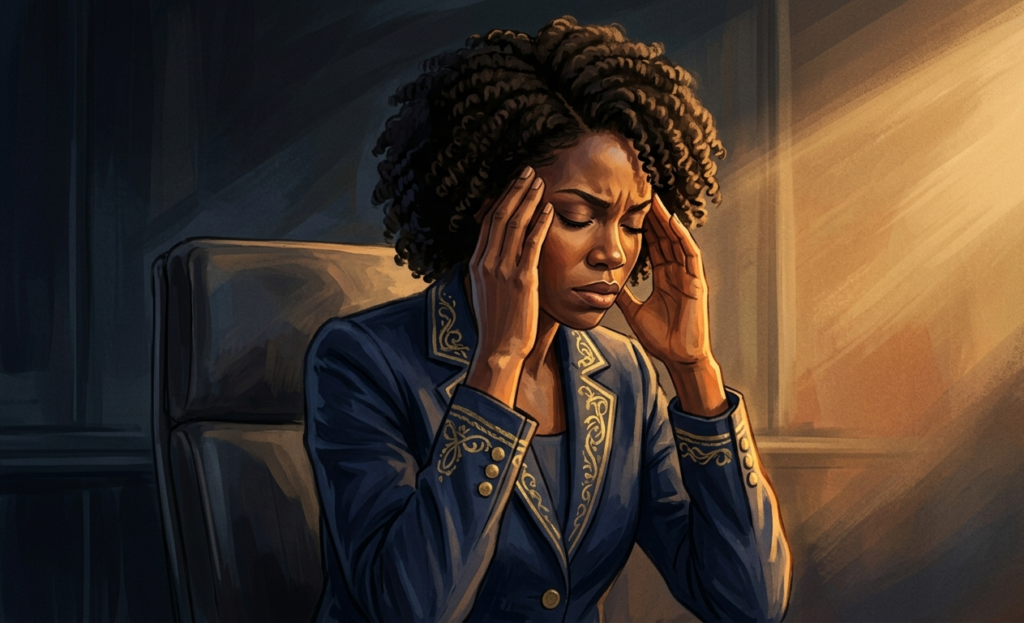
I read a book recently that stopped me in my tracks. It’s called I Almost Lost My Mind by Irene Markjonathan, and it tells the story of a young woman named Asomdwe who went through something that many people experience but almost nobody talks about.
Asomdwe was a bright, faith-filled young woman, the kind of girl who loved God, loved learning, and had her whole future ahead of her. And then, seemingly out of nowhere, her mind became a war zone.
Negative, blasphemous, terrifying thoughts began flooding her mind. Thoughts so vile she was afraid to be alone. Thoughts so relentless she couldn’t read, couldn’t sleep, couldn’t concentrate. She would sit in class pressing her hands against her ears, trying to silence voices that nobody else could hear.
And here’s what nearly destroyed her: she believed those thoughts were hers.
She believed that because the thoughts were happening inside her head, they must have come from her. That they were her truth. That they defined who she was.
She spiralled so far into that belief that she began to think she was losing her mind entirely. She was afraid to tell anyone because she feared being labelled crazy. She suffered in silence for months, convinced she was beyond help.
And then she read one line in a book that changed everything. The insight was simple but devastating in its clarity:
Those thoughts were not her thoughts.
They were being projected into her mind, and the moment she accepted them, they became hers. But they were never hers to begin with.
She described the revelation like this: it’s like someone dumping trash at your doorstep. The rubbish is not yours. Having it at your doorstep doesn’t make it yours, and it doesn’t make you dirty. It wouldn’t make any sense to cry over it or feel guilty about it. All you have to do is throw it back and lock your gate.
That one shift, from “these are my thoughts” to “these are suggestions I can reject”,changed the entire trajectory of her life.
She went from barely surviving to graduating as valedictorian. She went from isolation to building deep friendships. She went from being a prisoner of her own mind to becoming someone who helps others fight the same battle.
When I read that story, I thought about every person out there who is carrying a thought they never chose:
The person who believes he’ll never be successful because his father told him he was “not smart enough”
The woman who’s convinced she’s unlovable because one relationship didn’t work out.
The person who has shrunk their ambitions to fit a narrative that someone else wrote for their life.
And I thought: how many of us are living under the weight of thoughts we never even agreed to carry?
For many of us, the thoughts we carry didn’t start in adulthood. They were planted much earlier — in childhood, by words spoken over us before we had the language or the power to challenge them.
A parent’s offhand comment.
A caregiver’s anxiety transferred onto us.
A painful experience that wrote a rule we never agreed to.
If you’ve never gone back to examine what was planted in those early years, the roots are still running your life from underneath.
This is exactly what our Healing Childhood Trauma Webinar was designed for: to help you understand where these limiting beliefs were planted so you can finally uproot them with intention.
4. WHAT YOU REPLACE THEM WITH MATTERS
Here’s something I want you to understand: this isn’t just about getting rid of bad thoughts. It’s about deliberately building a new thought life.
You’re not just clearing the weeds, you’re planting a garden. And a garden needs consistent feeding.
What are you reading?
What are you listening to?
Who are you spending your time with?
What environments are you placing yourself in?
Every one of these is an input, and your mind is processing all of them, forming pathways, building beliefs, shaping identity.
If you surround yourself with conversations about lack, limitation, and impossibility, your mind will build a framework for a small life, no matter how many affirmations you recite in the morning.
But if you feed your mind the Word of God, the right teaching, the right community, the right books, the right conversations, your mind starts to build a new framework. One that aligns with who you actually are and what you’re actually capable of.
This is what Romans 12:2 means when it says, “Be transformed by the renewing of your mind.” Renewal isn’t a one-time event. It’s a daily practice of choosing what gets to occupy space in your head.
This is also why I created The Mindset Reset. Because knowing that your thoughts can be challenged is the first step, but having a structured process for actually replacing limiting beliefs with empowering ones that’s where real transformation lives.
Everything you’ve learned in today’s post is the awareness. The Mindset Reset is the action plan.
You just learned that replacing your thoughts matters as much as rejecting them. Here’s where to start.
Reclaim Your Mind gives you 10 ready-made declarations designed to counter the most common lies running your mind — paired with scriptures so you’re not just speaking words, you’re speaking truth. It’s free, and it works best when you read it out loud.
5. YOUR MIND DOESN’T ALWAYS THINK IN WORDS

There’s one more thing I need you to understand because if you miss this, you’ll walk away from this post thinking you’ve got it handled, and then wonder why you’re still being blindsided by emotions you can’t explain.
Not every thought announces itself as a sentence in your head.
Sometimes a thought doesn’t sound like words at all. Sometimes it shows up as an impression. A feeling. A sudden wave of anxiety.
A heaviness you can’t name. A flash of shame. A quiet ache of loneliness. And because it arrives as an emotion rather than a statement, you don’t recognise it as a thought. You just say, “I don’t know why, but I just feel this way.”
But here’s what I want you to see: before it became a feeling, it was a thought. Before the fear set in, something was whispered. Before the anxiety arrived, there was an image of chaos in your mind.
Before the shame landed in your chest, a suggestion had already walked through your mind. You just didn’t catch it because it didn’t come dressed as words.
Your emotions are not orphans.
They didn’t appear from nowhere. Every feeling you experience was fathered by a thought and if you trace the emotion back far enough, you’ll find it.
When you feel sudden anger toward someone you love, pause and ask yourself: What have I been thinking about this person? You’ll likely discover that before the anger arrived, you were replaying every wrong thing they’ve done to you.
You were rehearsing the offence. The emotion didn’t start the conflict, a thought did. The emotion just carried it into your body.
When anxiety grips you before a meeting, a conversation, or a new opportunity, ask: What have I been picturing? You’ll often find that before the anxiety showed up, you were already watching a mental film of everything that could go wrong. The fear didn’t come first. The image did.
When self-pity settles over you like a fog, trace it. Before you started feeling sorry for yourself, you were subconsciously reviewing all the negative things you’ve had to endure, all the ways life has been unfair, all the evidence that things never work out for you. The emotion was responding to a narrative you were running in the background without even realising it.
And here’s what I really want you to hear:
Your very next thought after reading this post is most likely going to be an image, not a sentence. That’s why this is so easy to miss.
You’re not always hearing a voice in your head telling you what to think. Often, it’s subtle. Subliminal. A flash of a scenario. A mental picture of a worst case. An image that brings fear or rejection or shame or sadness, and you feel the emotion without ever catching the thought that triggered it.
In fact, these images can bombard you, moving so fast across the terrain of your mind that you won’t even be aware of them in the moment.
One image triggers the next, which triggers the next, and they’re racing through your mind before you’ve had a chance to examine a single one. You don’t catch them while they’re running. You only notice them after their effect:
When your mood has shifted, when your chest feels tight, when you suddenly feel irritated or defeated or anxious and you can’t explain why.
And that’s okay. If you couldn’t catch them while they were moving through your mind, you haven’t missed your window. When they show up as emotions, as a shift in your mood, as a reaction that feels disproportionate, as a heaviness that wasn’t there ten minutes ago, that is your second opportunity. The emotion is the signal flare.
It’s telling you: something just ran through here. Go back and find it.
When you start doing this — tracing the emotion back to the thought, something powerful happens. You’ll realise that you have far better control over your emotions and your reactions to events than you ever thought possible.
Not because you’ve learned to suppress what you feel, but because you’ve learned to address what caused it. You’re no longer at the mercy of feelings that seemed to come from nowhere. You’re catching the thought that fathered them, even if you’re catching it on the way out rather than the way in, and you’re deciding whether it gets to stay.
So the next time you’re upset, anxious, ashamed, or drowning in a feeling you didn’t ask for, don’t start with the emotion. Start with the question: What have I been thinking, or seeing about this situation that is making me feel this way?
When you do this consistently, you’ll discover something: sometimes your emotions lie to you.
Not because you’re weak or broken, but because they’re responding to thoughts, images, and imaginations about a person, a situation, or an event that may not even be true. The emotion is real. But the thought that fathered it might be a lie.
YOUR MIND IS A BOARDROOM, NOT A WAITING ROOM
Let’s bring it all together.
You are not your thoughts. You are the one who decides which thoughts get to stay. Every thought that enters your mind, whether it arrives as a word, an image, an impression, or an emotion is a suggestion.
Some are helpful. Many are old narratives, borrowed fears, cultural scripts, and lies that were spoken over you by people who didn’t know any better or by an enemy who intends to destroy you and take control of your life
Ready to Take Back Control of Your Mind?
The Mindset Reset is an 8-hour course designed to help you identify the limiting beliefs holding you back, uproot them, and replace them with a mindset built for the life of your dreams. If today’s post opened your eyes, this course gives you the tools to implement what you’ve just learned
Next week, we close out this Mindset Month series with something I’m really excited about: now that your mind is being renewed, how do you actually use it to build the life you want? This post will help you in the next season of your growth.
I’ll see you in my next post.❤️
Key Takeaways
- Today, you learned that the lie keeping most people stuck is the assumption that thinking something makes it theirs.
- You learned that every thought is a pitch, and you are the decision-maker at the head of the table.
- You saw through Asomdwe’s story that one shift in understanding from “these are my thoughts” to “these are suggestions I can reject”, can change the entire trajectory of a life.
- You learned the form of thoughts that ambush most people: the images, impressions, and emotions that usually don’t announce themselves as thoughts at all.
Frequently Asked Questions (FAQ)
Are my thoughts really mine?
Not all of them. Many of the thoughts that run through your mind were shaped by external sources: things people said to you, cultural narratives you absorbed, painful experiences that created unexamined rules, or spiritual influences projecting ideas in first person.
A thought being in your head doesn’t automatically make it yours. You become the owner of a thought when you accept it and allow it to shape your beliefs and actions.
How do I stop believing negative thoughts about myself?
The first step is recognising that a negative thought is a suggestion, not a fact. Trace it to its source by asking “Who said that?”
You’ll often find it came from a specific person, experience, or season. Once you see where it originated, it loses its authority. Then actively replace it with something more true: a scripture, a personal declaration, or evidence from your own life that contradicts the lie.
Where do negative thoughts come from?
Negative thought patterns typically originate from five key sources: words spoken over you in childhood by:
- Parents or caregivers
- Judgements from authority figures like teachers
- Cultural or societal narratives about your identity or potential
- Painful experiences that created unexamined beliefs
- And spiritual opposition designed to keep you from walking in your purpose.
Understanding the source is essential because it helps you challenge the thought with precision rather than just trying to suppress it.
Can you change your thought patterns as an adult?
Absolutely. Neuroscience confirms that your brain retains neuroplasticity throughout your entire life, meaning it can form new neural pathways at any age.
The process involves consistent repetition of new thought patterns through:
- Declaration
- Meditation on The Word of God
- Changing your inputs (what you read, listen to, and surround yourself with)
- And daily practices like the Thought Audit.
Change doesn’t happen overnight, but it does happen with intention and consistency.
Recent Posts
-

Service: The Part of Leadership Nobody Wants to Talk About (and 7 Lessons It Teaches You!)
October 16, 2026 -

Self-Mastery: The First Attribute of Every Great Leader (and 10 Steps to Build It)
October 9, 2026 -

How to Create an Offer That Sells: Pricing, Packaging and Positioning Made Simple
October 2, 2026 -

How to Make Your Annual Income in a Month: The Wealth Mastery Skill Nobody Taught You
September 25, 2026 -

The Art of Effective Communication: 5 Communication Shifts That Will Transform How People Respond to You, Your Brand, and Your Value.
September 18, 2026